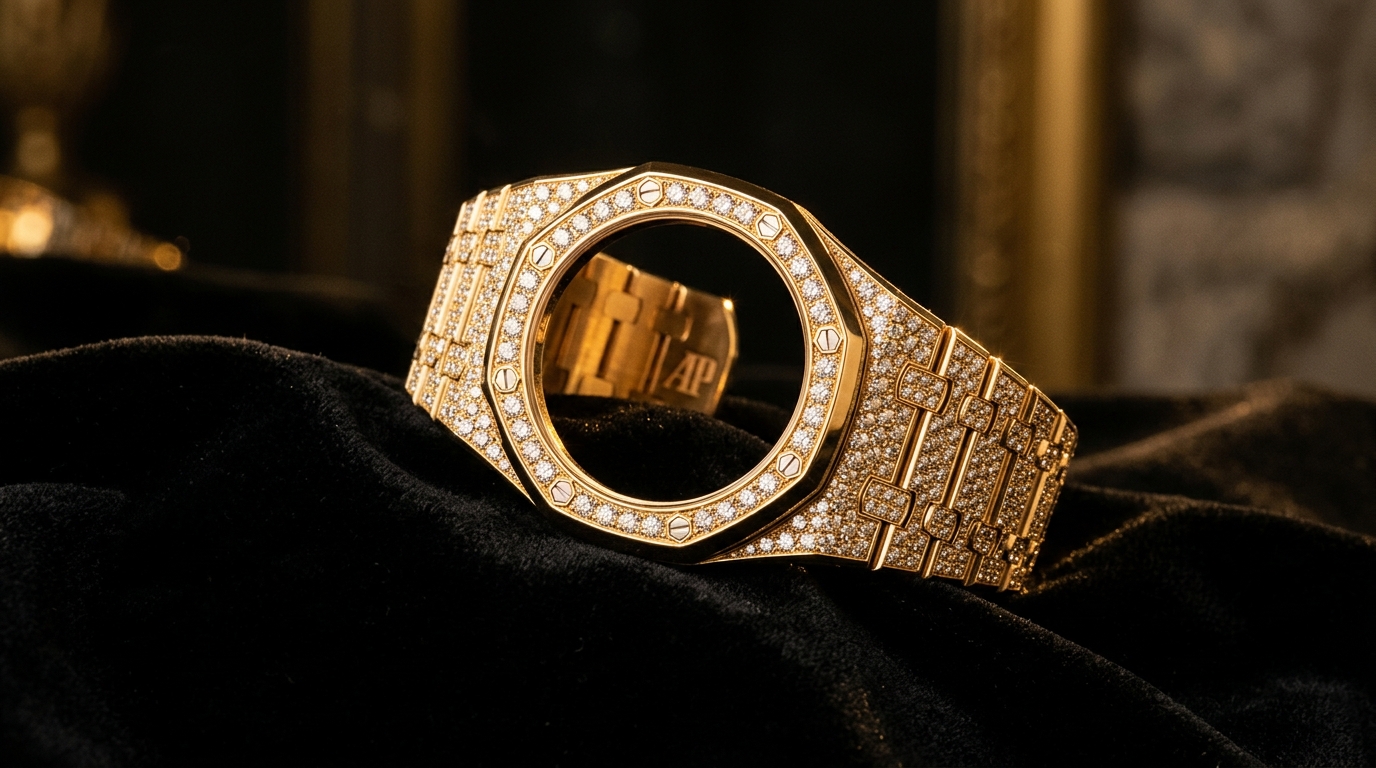
Audemars Piguet is entering high jewelry. But I don't think jewelry is the real story.
During Paris Fashion Week on October 2, 2026, AP launched its first dedicated high jewelry collection - the Royal Oak Joaillerie - built entirely around the design codes of its most recognizable creation: the Royal Oak.
At first glance, it looks like a natural expansion. Cuffs, chokers, necklaces and earrings translating the Royal Oak aesthetic beyond the wrist. But I think the smarter move is what sits underneath it.
AP isn't trying to become a jewelry brand. It's using jewelry to make its watchmaking more valuable.
The Royal Oak Has Always Lived Between Watchmaking and Jewelry
Gerald Genta's 1972 masterpiece was never just a watch. Its octagonal bezel, exposed hexagonal screws, and integrated bracelet borrowed from industrial architecture, but the finish - alternating satin-brushed surfaces and mirror-polished bevels - belonged to fine jewelry. From day one, the Royal Oak existed at the intersection of watchmaking and adornment.
That line blurred further in 2016 when AP partnered with Florentine jeweler Carolina Bucci on the Royal Oak Frosted Gold. Bucci introduced an ancient goldsmithing technique - the Florentine finish - where a diamond-tipped tool strikes the gold surface thousands of times, creating tiny indentations that catch light like diamond dust. Without a single gemstone, the watch sparkled like high jewelry.
The Frosted Gold wasn't just a product. It proved AP could translate jewelry craft into watchmaking vocabulary without diluting either discipline. It became a core pillar of the modern catalog, expanded across complications and materials, and catalyzed the brand's growth with female collectors who wanted mechanical substance, not just smaller pink watches.
Now, those same codes are being taken off the wrist entirely. And the timing is no accident.
19 Pieces. Three Lines. One Architecture.
The Royal Oak Joaillerie comprises 19 inaugural pieces - necklaces, chokers, cuffs, and earrings - all built on the Royal Oak's structural DNA: the tapering link geometry, mirror-polished chamfers, and the iconic octagonal clasp mechanism. Every piece fastens using that signature octagonal lock, rendered in gold, blue titanium, or blackened titanium.
The collection is divided into three conceptual lines, each drawing from the landscapes and light of AP's birthplace in the Vallee de Joux:
Frosted Gold
The Bridge
The most direct translation from watch to jewelry. Extends Carolina Bucci's Florentine hammering technique - the diamond-dust sparkle that defined the 2016 watch - into standalone cuffs, chokers, and bracelets. 18k white, pink, and yellow gold. No gemstones needed. The technique is the jewel.
Dream of Joux
The Expressive
The most colorful line. Inspired by the valley's frozen lakes, wild flora, and night skies. One-of-a-kind 18k gold cuffs - Sunburst, Blue Moon, Tree of Life - set with multi-colored sapphires, spessartite garnets, tourmalines, tsavorites, and cascading pear-shaped diamonds. A tie necklace in anodized blue titanium links, snow-set with blue sapphires.
Risoud Eclipse
The Dramatic
The moodiest direction. Black PVD titanium structured links paired with sugarloaf-cut emeralds and brilliant-cut diamonds, evoking a solar eclipse over the dense Risoud Forest. High-impact chokers, necklaces, and cuffs that feel like wearing a piece of the night sky.
Prices range from CHF 48,000 to several million. Distribution is private trunk shows and exclusive client events - no aggressive retail rollout.
The Atelier des Etablisseurs: Why the Timing Matters
At Watches and Wonders earlier this year, AP introduced the Atelier des Etablisseurs - a collaborative workshop reviving the 18th-century etablissage system of the Vallee de Joux. It brings together master independent artisans and in-house specialists: engravers, gem-setters, lapidarists, enamellers, and hand-skeletonisation experts.
The opening trilogy included the Etablisseurs Galets (pebble-inspired asymmetrical jewelry watch), the Etablisseurs Nomade (a transformable pocket-to-table titanium piece with hand-skeletonized movement), and the Etablisseurs Peacock (a sculpted, gem-set secret watch shaped like an organic animal form).
High jewelry gives those capabilities another canvas.
The Atelier wasn't just about launching new watches. It was about demonstrating that AP possesses the full spectrum of metiers d'art capabilities - gem-cutting, stone-setting, engraving, champlevé enameling, hand-skeletonisation - that luxury jewelry houses spend decades building. The Royal Oak Joaillerie becomes a testing ground for those skills, feeding artisanal mastery directly back into the watchmaking.
In a notable departure from modern luxury secrecy, AP publicly credits every independent artisan - jewellers, case-makers, movement designers like Guy Froidevaux, Vanessa Lecci, and Mario Senape - who contributes to each creation. Transparency as brand currency.
Brand World-Building, Not Category Extension
This is where most analysis gets it wrong. The instinctive reaction to "watchmaker launches jewelry" is to evaluate it as a brand extension - the same way Cartier moved from jewelry into watches, or Bulgari expanded from Roman high-jewelry into Swiss horology.
But AP is doing something different. It's not extending into a new category for revenue. It's deepening the meaning of its existing one.
| Dimension | Category Extension | Brand World-Building (AP) |
|---|---|---|
| Intent | "What else can we sell?" | "What else can our brand mean?" |
| Revenue Goal | Open a new P&L line | Increase the value of the existing one |
| Volume | Scale-driven | Limited production, no aggressive sales target |
| Distribution | Retail expansion | Private trunk shows, existing client relationships |
| Risk Profile | Dilution of core identity | Reinforcement of core craftsmanship |
| Success Metric | Jewelry revenue as % of total | Brand desirability, client depth, savoir-faire perception |
The strongest brand extensions don't ask, "What else can we sell?" They ask, "What else can our brand mean?"
The Numbers Behind the Decision
AP's financial position makes this move possible without it needing to be a revenue play.
As a privately-held, family-owned manufacturer producing roughly 53,000 pieces at an average price exceeding CHF 50,000, AP doesn't need jewelry to fill a revenue gap. The Royal Oak alone drives 88% of sales. Instead, jewelry serves three strategic objectives:
1. Deepen relationships with existing clients
Give top-tier collectors more ways to engage with the brand without producing more watches that would dilute scarcity.
2. Attract a growing female clientele
CEO Ilaria Resta has explicitly positioned women as AP's fastest-growing segment, rejecting the "pink it and shrink it" approach. Jewelry creates another entry point rooted in mechanical and material substance.
3. Sharpen savoir-faire perception
High jewelry demands skills (lapidary work, stone-cutting, complex gem-setting) that feed back into watchmaking. It's an investment in capability, not just catalog.
Ilaria Resta's Luxury House Thesis
Resta didn't come from horology. She joined AP from the global consumer goods and beauty sector - bringing an outsider's perspective to a 150-year-old watchmaker. Her leadership has been defined by three principles:
Circular Leadership
Shifting from rigid top-down hierarchies to foster creative freedom, transparency, and collaboration among artisans and management. The Atelier des Etablisseurs publicly credits every independent craftsperson by name.
Experiential Retail (AP Houses)
Expanding AP House spaces (Singapore, historical hubs) as immersive lifestyle and hospitality venues rather than traditional retail stores. Brand relationship through experience, not transaction.
Substance Over Shrinkage
Rejecting the legacy approach of making smaller, quartz-driven women's watches. Instead, AP highlights high complications, ceramic, and mixed gold alloys for female collectors. The Royal Oak Mini Frosted Gold - designed for stacking - became the direct catalyst for the jewelry collection.
Where AP Sits on the Extension Spectrum
Other luxury houses have navigated this intersection from the opposite direction - jewelry brands extending into watches. Each approach carries different risks:
| Brand | Direction | Strategy | Primary Risk |
|---|---|---|---|
| Cartier | Jewelry → Watches | Iconic shapes, broad price spectrum | Over-exposure |
| Bulgari | Jewelry → Watches | Bold design + Swiss manufacture | Fashion-watch stigma |
| Van Cleef & Arpels | Jewelry → Watches | Poetic complications, ultra-low volume | Niche stagnation |
| Audemars Piguet | Watches → Jewelry | Craftsmanship amplification, limited production | Minimal (controlled scarcity) |
The crucial difference: Cartier, Bulgari, and Van Cleef moved into watches to create new revenue streams. AP is moving into jewelry to reinforce its existing identity. There is no plan to scale jewelry into a major P&L line. The value flows in the opposite direction - back into the perception of watchmaking.
The Lesson for Luxury Brands
For AP, jewelry can deepen the relationship with existing clients, attract a growing female clientele, and create more ways for people to experience the brand without diluting what makes it distinctive.
The strongest brand extensions don't ask, "What else can we sell?"
They ask, "What else can our brand mean?"
And AP seems to have a very clear answer. It means not just measuring time, but shaping how time is worn, experienced, and treasured - in every form that craftsmanship can take.
EDITORIAL DISCLAIMER: This case study is independent academic analysis by Akshith Vinukonda (ESSEC Business School Singapore). It is not affiliated with, endorsed by, or produced in collaboration with Audemars Piguet, Prada Group, Cartier, Bulgari, Van Cleef & Arpels, or any entity mentioned. All brand names, trademarks, and images are the property of their respective owners. Financial estimates are sourced from Morgan Stanley/LuxeConsult industry reports and Business of Fashion.