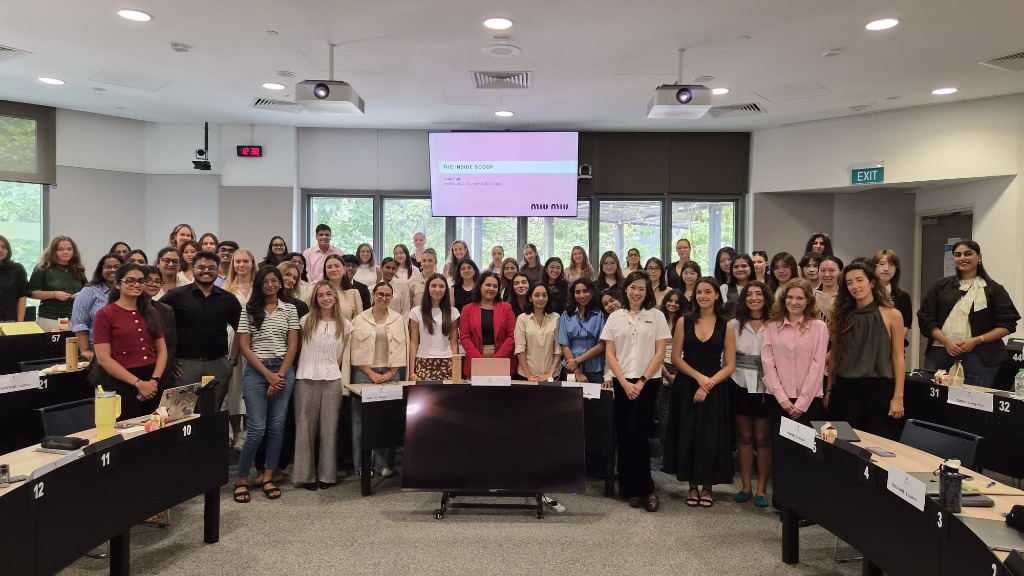
A Classroom Perspective: Beyond the Polished Campaign
Today, Lynn Chou, Managing Director of Miu Miu Singapore, visited our college as a guest speaker.
I went into the session expecting to learn about her personal journey into luxury fashion leadership. I came away thinking about something far bigger: how many interlocking parts of a luxury business have to work in unison to create the emotional resonance that clients ultimately associate with a brand.
During the session, we covered boutique retail excellence, customer data knowledge, bespoke clienteling, the emerging boundaries of artificial intelligence, and how Miu Miu fiercely protects an irreverent, distinct identity alongside Prada under the shared umbrella of the Prada Group.
“What interested me most was how tightly these topics connect. Luxury strategy cannot be decoupled into abstract branding in one tower and retail execution in another. The customer never experiences an abstract brand; they experience an advisor, a salon, an invitation, and a product.”
Retail Excellence Starts on the Ground
If there was one unmistakable foundation that resonated throughout our lecture hall, it was that luxury careers cannot be navigated exclusively from an ivory-tower spreadsheet. Working effectively in luxury requires understanding the realities of the retail floor.
Boutique retail is not merely a distribution channel or an operational terminal; it is the primary arena where the brand promise is tested against reality. While fashion houses invest millions into high-fashion shows in Paris and cinematic digital campaigns, that entire investment converges upon a single human touchpoint: the Client Advisor.
Active Listening & Curation
Client advisors decode non-verbal hesitation, lifestyle shifts, and aesthetic appetites far faster than any transaction log.
Sensory Translation
Translating material craftsmanship, Matelassé leather textures, and runway silhouettes into personal relevance for a specific client.
The Reverse Signal Loop
Frontline teams directly capture pricing objections, sizing nuances, and emerging street preferences, feeding critical intelligence back to headquarters.
As highlighted in the Prada Group’s official Remix Retail Stories, the retail network represents a vibrant cultural ecosystem where service quality, architectural atmosphere, and human intimacy forge lifelong bonds. Store teams absorb customer motivations and objections in real time. When headquarters marketers plan product allocations or seasonal communications without grounding themselves in boutique dialogue, marketing becomes an academic exercise devoid of pulse.
How Spatial Design Embodies Miu Miu’s Persona
Brand positioning is made physical through boutique architecture. Two benchmark expressions within Miu Miu’s global portfolio illustrate how spatial design reinforces identity:
The brand's classic boutique interior wraps entire salons in monochromatic damask silk wallpaper, golden accents, and plush velvet seating. This evokes a private, intimate boudoir-sensual, rebellious, and unapologetically feminine.
In Tokyo’s Aoyama district, opposite Prada’s monumental glass polygon, Herzog & de Meuron designed an understated metallic box with an inverted steel canopy. Instead of looking open and transparent, it shields the interior like a confidential jewel case, embodying intimate intrigue.
From Customer Data to Clienteling
During the session, we explored how headquarters profiles purchasing behaviour to identify which clients will find a newly arriving collection or private capsule relevant. In luxury marketing, this is where CRM evolves from a database function into high-touch clienteling.
Clienteling in luxury is fundamentally distinct from mass-market retargeting. Mass marketing blasts discounts to broad cohorts; luxury clienteling equips the boutique advisor with relevant context to initiate an intimate, respectful conversation.
As documented in the official Miu Miu Singapore Privacy Policy, the company processes customer personal data for “preference research, personalized customer care, and communications regarding products, services, and exclusive events” upon client consent.
The official Privacy Policy explicitly establishes customer profiling and data analysis for preference matching; however, the public policy does not explicitly establish that Miu Miu uses Artificial Intelligence tools for these activities. While our academic session explored the potential and industry applications of AI in profiling, publicly verified corporate filings and personal classroom discussion must remain strictly distinct.
In luxury, privacy and consent are not regulatory checkboxes-they are expressions of respect. The moment personalization feels like automated surveillance or aggressive retargeting, luxury prestige evaporates. Personalization must feel considered, discreet, and gracious.
Where Does AI Fit into Luxury Marketing?
This brings us to the pivotal question confronting every luxury maison in 2026: Can artificial intelligence make luxury personalisation more meaningful without making the experience feel automated?
To answer this question analytically rather than with Silicon Valley hype, we must examine current industry research from leading luxury advisory institutions.
In their joint benchmark report, Luxury & Technology: Artificial Intelligence - The Quiet Revolution (survey conducted May–July 2024 across member luxury brands), Bain & Company and Comité Colbert measured the actual partial or scaled adoption rates of AI:
Demand & Inventory Coherence
Deloitte's Global Powers of Luxury 2026 underscores that leading luxury groups are using analytics to solve supply allocation imbalances-ensuring rare runway pieces arrive at flagships with proven local client demand, preventing both stockouts and brand-diluting inventory buildup.
When AI Meets Desire
In When AI Meets Desire, McKinsey argues that luxury technology must remain human-centered. AI should never impersonate the relationship; rather, it should act as an invisible cognitive assistant that frees the human advisor to deliver unhurried, empathic hospitality.
Strategic Benefits vs. Critical Vulnerabilities
- 1. Contextual Relevance: Identifying subtle behavioral signals so outreach occurs only when a product matches verified tastes, eliminating unwanted contact.
- 2. Employee Enablement: Preparing advisors with client purchase history and styling affinities so they spend less time searching screens and more time listening.
- 3. Omnichannel Coherence: Ensuring a client recognized in Milan or Paris experiences immediate, seamless recognition when visiting the Singapore flagship.
- 1. Privacy & Consent Erosion: Crossing the delicate boundary between attentiveness and intrusive surveillance.
- 2. Inaccurate Algorithmic Inferences: Recommending leather goods based on a gift purchase intended for a spouse.
- 3. Generic 'Black Box' Suggestions: Recommending standard bestsellers instead of curating genuine surprise.
- 4. Customer Contact Fatigue: Bombarding high-net-worth clients with synthetic communications.
- 5. Overdependence on Automation: Advisors losing their personal instinct, curiosity, and taste.
- 6. Loss of Human Discretion: Luxury relies on personal judgement, warmth, and grace-qualities algorithms cannot replicate.
“Luxury has always involved knowing the client. The interesting question is not simply whether AI can make this process more efficient, but whether it can help brands understand customers better without weakening the human relationship.”
Miu Miu vs Prada: Two Maisons, One Creative Genius
One of the most compelling strategic challenges explored during our session was how Miu Miu maintains a fiercely distinct identity while sharing its parent group and creative authorship with Prada.
Both houses share the singular creative visionary Miuccia Prada. Yet reducing their difference to a lazy demographic cliché-such as claiming “Prada is for mature professionals, and Miu Miu is for Gen Z”-misses the entire philosophy of luxury portfolio governance. Both brands cater to discerning consumers across generations; what separates them is not age, but mindset and artistic codes.
| DIMENSION | PRADA | MIU MIU |
|---|---|---|
| Brand Positioning | Conceptuality, intellectual rigor, structural purity, and modern codes that transcend trends (Prada Brand Page). | Rebellious, unconventional femininity, conscious contradictions, and experimental spontaneity (Miu Miu Brand Page). |
| Creative Expression | Uniformity, architectural minimalism, utilitarian luxury, and deliberate restraint. | Naïf charm, layered vulnerability, playful subversion of schoolgirl and bourgeois codes. |
| Design Language | Re-Nylon, Saffiano leather, sharp tailoring, clean lines, and neutral, sober palettes. | Matelassé gathered leather, low-slung micro-skirts, raw hems, ballet flats, and crystal embroidery. |
| Cultural Storytelling | Fondazione Prada, architectural patronage, contemporary art dialogues, and philosophical cinema. | Women’s Tales film commissions, Literary Club symposia, and performative installations (*Tales & Tellers*). |
| Retail Experience | Epicenters (OMA/Rem Koolhaas), black-and-white checkered marble, monumental modernist geometry. | Intimate damask-lined boudoirs, velvet salons, and confidential private spaces like Aoyama. |
| Distinctive Brand Codes | The enameled metal triangle logo, intellectual 'ugly chic', utilitarian elegance. | The curved sans-serif embossed logo, Matelassé texture, contrast collegiate styling. |
Sharing a Parent Group Does Not Require Sharing Brand Personality
From a luxury portfolio standpoint, Prada Group's greatest strength is allowing Miu Miu to remain completely true to its own contradictory, provocative character. If Miu Miu were homogenized into a secondary 'diffusion' line of Prada, it would dilute both brands. By preserving distinct aesthetic codes, visual identities, and cultural initiatives, Prada Group captures complementary luxury desires across the global market.
Campaigns, Culture & Brand Storytelling
How does this differentiated positioning manifest in real creative output? A review of Miu Miu's recent official campaigns and cultural patronages reveals how narrative consistency is maintained across every touchpoint.
Spring/Summer 2026: “On Cloud Nine”
Documented in Prada Group’s official press release, the On Cloud Nine campaign pairs ethereal styling with intentional dissonance. The casting, photographic realism, and tension between sportswear and delicate lace embody Miu Miu's core proposition: effortless, slightly disheveled intellectual luxury.
2026 Leather Goods Campaign
Released in April 2026 disclosures, the leather-goods campaign centers on artisanal utility. Iconic silhouettes like the Wander and Arcadie are shown lived-in, styled with personalized charms and functional clutter-connecting high-craftsmanship leather to genuine daily life.
Engaging Communities Through Literature, Cinema & Art
Miu Miu has built one of the most culturally active brand universes in modern luxury, offering audiences substantive reasons to connect with the brand independent of a transactional handbag purchase:
A groundbreaking series of short film commissions directed exclusively by women filmmakers, celebrating complex female perspectives at the Venice Film Festival.
An immersive multidisciplinary installation presented at Art Basel Paris, exploring oral history, memory, and feminist performance art.
Curated literary salons honoring pioneering 20th-century female writers (such as Alba de Céspedes and Sibilla Aleramo) in Milan and global capitals.
Cultural pop-up kiosks in Paris, New York, and Seoul distributing free classic literature, positioning the Maison as an intellectual companion.
The Commercial Reality: Deconstructing Growth and High Comps
A luxury brand strategist cannot look at cultural initiatives or creative buzz in isolation. Marketing must always be contextualized against hard commercial reality.
Examining Prada Group’s latest audited financial disclosures reveals a fascinating case study in commercial momentum, high comparison bases, and long-term brand equity governance.
Financial commentators often misread a growth deceleration from +35% to +2.5% as a sign of waning brand desirability. In commercial reality, Q2 2026’s +2.6% growth was achieved against a monumental comparison base of +40% growth in Q2 2025. Consolidating volume after an exponential surge while sustaining full-price sell-through is the mark of mature brand governance, not a failed marketing strategy.
*Important distinction: These figures reflect direct-to-consumer retail sales growth, which should not be conflated with total group revenue, operating margin, or a direct quantitative measure of overall brand equity.
As Prada Group management emphasized in their FY2025 earnings statement and H1 2026 report, Miu Miu’s sustained commercial health is driven by disciplined retail elevation, product category expansion, and strong client relationships in key luxury hubs like Singapore.
My Personal Marketing Takeaways
Synthesizing Lynn Chou’s session insights with my independent research into Prada Group and industry benchmarks, here are five core principles I carry forward as a junior luxury strategist:
Understand retail before you try to improve it.
Learn how the customer actually encounters the brand in the boutique. Strategic concepts conceived in boardrooms must withstand the real-world pressures of client objections, fitting room choreography, and frontline service delivery.
Personalisation is about relevance, not message volume.
One well-timed, thoughtful, and exquisitely curated contact is infinitely more valuable than five automated push notifications. In luxury, restraint and discretion are the ultimate hallmarks of prestige.
AI should strengthen the customer relationship, not impersonate it.
The proper division of labour matters: let algorithms handle pattern detection, background preparation, and inventory coherence so that human advisors can dedicate their full attention to warm, unhurried personal connection.
A parent group needs sharply distinct brand identities.
Prada and Miu Miu demonstrate why differentiation must be fiercely maintained even under shared ownership and creative leadership. Protecting separate creative languages preserves brand equity across a multi-brand portfolio.
Creative desirability and commercial performance must be managed together.
A runway show, leather goods campaign, or boutique experience cannot exist solely for aesthetic acclaim. Every consumer touchpoint must contribute to long-term commercial health, full-price sell-through, and sustainable brand equity.
From Brand Strategy to Client Experience
Original Strategic Framework · Akshith Vinukonda
This conceptual framework illustrates the systemic feedback loop connecting executive brand positioning to the living customer encounter-and how frontline intelligence circulates back to headquarters:
Brand Identity & Positioning
Maison philosophy, codes, creative vision & multi-brand governance
Product & Creative Expression
Runway styling, Matelassé craftsmanship, casting & seasonal campaigns
Retail & Communication Execution
Boutique architecture, visual merchandising, Damask salons & digital touchpoints
Customer Interaction & Feedback
Client advisor dialogue, service choreography, trying-on, objections & demand signals
Clienteling & Relevant Personalisation
Privacy-compliant preference profiling, launch curation & private previews
Relationship Development & Commercial Outcomes
Emotional loyalty, full-price conversion, lifetime customer equity & high-base growth
Customer signals and frontline store feedback circulate continuously back to Stages 01, 02, and 03-informing future assortment allocations, product refinements, and brand governance decisions.
Sources & Further Reading
Every factual assertion, benchmark figure, and corporate disclosure cited in this analysis is grounded in publicly available audited records and accredited research:
“This is an independent learning and marketing-analysis project based on a guest-speaker session, publicly available research and my own interpretations. It is not affiliated with or endorsed by Miu Miu or Prada Group.”
Explore More Brand Strategy Research
AI in Luxury Personalisation →
How high-end Maisons leverage predictive client modeling without eroding human intimacy.
Louis Vuitton: Beyond the Monogram →
LVMH’s Client Advisor model and the delicate dance between automation and exclusivity.
Dior: Heritage & Architecture →
Translating historic haute couture codes into contemporary Asian boutique flagships.

ESSEC Business School MSc Marketing Management & Digital Candidate (Singapore) · Ex-Omnicom Senior Associate managing European programmatic campaigns for Porsche & Audi · Founder of ADvisor AI Agency.