
1. The Limits of the Chatbox
In modern marketing discourse, discussions about artificial intelligence often sound identical: a list of clever prompts, a screenshot of a chatbot generating a product description, and a promise that marketing productivity has permanently doubled.
Yet when marketing teams attempt to apply this in practice, frustration frequently follows.
Asking an AI model individual questions in an open conversation window is the organizational equivalent of hiring a smart intern and communicating exclusively through single post-it notes. Every new chat starts from zero context. The model forgets the brand tone of voice, overlooks earlier audience constraints, invents plausible-sounding facts, and delivers generic copy that reads like every other AI output on the internet.
The challenge facing marketers today is not learning how to write longer prompts. The challenge is architectural: Can a marketing team build an AI-powered operating system rather than relying on one-off conversations?
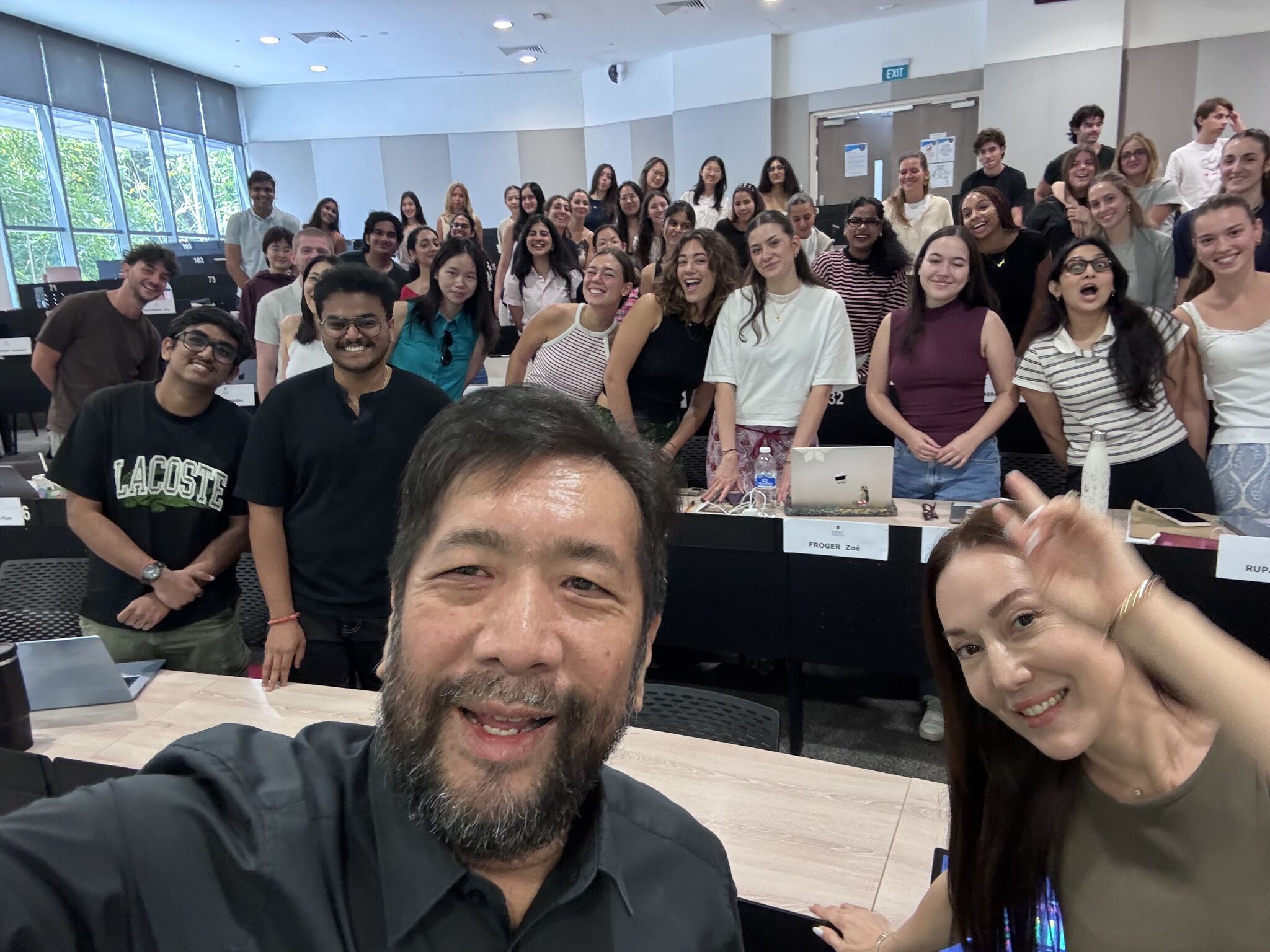
This was the central theme introduced by Nick Goh during his executive session at ESSEC Business School in Singapore. Rather than presenting generic productivity hacks, Nick explored how marketing practitioners can move from casual prompt engineering into workflow engineering, structured role specialization, and automated pipelines governed by human oversight.
2. The Yellow Pages Transformation
Nick Goh's perspective is particularly grounded because of the organization he leads. As Chief Executive Officer of Yellow Pages Singapore and YP Academy, his background combines traditional brand leadership with applied technology training [1].
For decades, Yellow Pages was known for its massive yellow telephone directories delivered to every doorstep and office in Singapore. As digital search engines and online marketplaces disrupted physical print directories, the enterprise had to reinvent its commercial reason to exist.
Under Nick's leadership, Yellow Pages transitioned from a legacy print publisher into a digital enablement and marketing training academy. His perspective is not that of a theoretical software evangelist. It is shaped by working with small and medium enterprises (SMEs) that have limited marketing headcount, tight budgets, and no tolerance for theoretical tools that fail to generate measurable business results.
When an SME adopts technology, it cannot afford complex experimentation for its own sake. It requires predictable customer acquisition, reliable lead follow-up, and repeatable marketing execution.
3. From Prompts to Workflows: Clarifying the Vocabulary
In popular technology commentary, terms like prompt, workflow, agent, and automation are frequently used as if they mean the same thing. Nick established clear boundaries between these concepts:
A single instruction or question delivered to a language model. It produces an immediate, isolated output with no persistent memory or downstream connection to other business tools.
A dedicated environment that pairs persistent contextual instructions (such as target customer personas, voice guidelines, and brand boundaries) with a curated reference library of documents. The model operates within defined guardrails across multiple conversations.
A multi-step sequence connecting different software applications. A trigger event, such as a customer submitting a website form, automatically passes data through enrichment APIs, language models, and notification tools according to deterministic business logic.
A system configured to execute specific sub-tasks, such as summarizing competitive research or drafting social copy, but designed with mandatory human review gates before any action is executed externally.
Understanding these distinctions is essential. When marketers confuse a prompt with a workflow, they expect a single chat query to solve problems that actually require an interconnected system.
From 2,000-Page Directory to Autonomous Growth Agent
Nick Goh shared how Yellow Pages Singapore reinvented its legacy database into an automated AI growth engine for SMEs. Click through the 5 connected stages of an autonomous marketing system:
Rather than waiting for a small business to buy a print directory ad, autonomous web agents monitor search query surges, business registration databases, and local commerce intent to identify prospective business clients in real time.
4. Claude Projects as a Virtual Marketing Department
One of the practical methodologies Nick demonstrated was configuring Anthropic's Claude Projects to function as specialized virtual team members [2].
Rather than using one general chat window for every task, a marketing team can establish separate project workspaces, each equipped with its own custom system prompt and knowledge documentation:
The Research Analyst
Trained to analyze competitor movements, customer reviews, and market reports. System instructions mandate citing sources, identifying data gaps, and summarizing findings in structured briefing tables.
The Brand Strategist
Focuses on positioning, value propositions, and messaging angles. Grounded with the brand's core values, brand architecture guidelines, and ideal customer profile (ICP) rubrics.
The Copywriter
Takes strategic briefs and drafts copy across formats: email newsletters, LinkedIn thought leadership, or landing pages. Governed by strict voice and tone rules that forbid generic AI cliches.
The Critical Reviewer
Acts as the internal skeptic. Explicitly instructed to challenge assumptions, flag unsupported claims, check consistency against brand guidelines, and highlight potential customer objections.
Separating these roles into distinct workspaces prevents the model from attempting to do everything at once. When research is kept separate from copywriting, the copywriter works from structured factual inputs rather than improvising claims.
5. The Critical Limitations of Multi-Role AI
While organizing AI into virtual roles is an effective structuring technique, Nick cautioned against a common misconception: assigning different personas to an AI model does not turn them into independent human experts.
All roles still rely on the same underlying foundation model. They share the same training data, the same blind spots, and the same tendency toward confident but inaccurate assertions. If the Research Analyst invents a market statistic, the Brand Strategist will accept that statistic as ground truth, and the Copywriter will weave it into promotional messaging.
This is why the Critical Reviewer role cannot substitute for human oversight. An AI reviewer cannot know what is truly happening on the retail floor, whether a product margin is commercially sound, or how local cultural sensitivities might react to a sensitive topic. Human accountability remains non-negotiable.
6. Practical Marketing Automation with n8n
To demonstrate how language models integrate into operational business workflows, Nick showcased the open-source automation platform n8n [3].
In a typical B2B marketing environment, following up on inbound inquiries requires hours of manual work: researching company headcount, reading company websites, preparing briefing notes for sales reps, and updating the CRM.
Nick illustrated how a five-step automated workflow can handle this administrative research while keeping human decision-making at the center:
Hypothetical Workflow: Inbound Lead Intelligence
- Webhook Trigger: A prospect submits an inquiry through a website form providing their name, company domain, and business requirements.
- Data Enrichment API: The system automatically queries external firmographic databases using the domain to retrieve estimated company size, industry classification, and location.
- AI Synthesis Node: Claude evaluates the enriched company profile against the agency's ideal customer profile rubric and formats a concise 3-paragraph executive briefing.
- Mandatory Human Review Gate: Execution pauses. An interactive notification card is posted to the team's internal Slack channel. A human team member reviews the brief and clicks Approve, Edit, or Reject.
- CRM Update: Upon human approval, the verified brief is committed to the CRM, and the account manager is notified to reach out personally.
Step four is the critical architectural design choice. In careless marketing setups, organizations attempt to automate outbound customer communication entirely, sending automated cold emails that damage brand reputation. By inserting a deterministic human validation gate, the workflow automates time-consuming research while ensuring that no customer ever receives an automated communication without human verification.
7. The Commercial Realities of AI in Marketing
What is the financial reality of deploying AI marketing systems? Does building automated workflows eliminate marketing payroll, or does it shift overhead into technical maintenance?
Nick provided a pragmatic perspective. Building automated marketing workflows introduces real operational costs and trade-offs:
- Software subscription costs across language model API tokens, automation platforms, and data enrichment services.
- Ongoing maintenance required when APIs change, website forms update, or workflow webhooks fail.
- Data privacy compliance to ensure confidential client information is not transmitted to external models without proper safeguards.
- The necessity of training team members to review AI outputs with critical skepticism rather than rubber-stamping suggestions.
Technology does not remove the need for skilled marketers. It shifts the marketer's role from manual copy production to systems architecture, prompt design, and editorial judgment.
8. Personal Reflection: Becoming an Architect of Systems
Before attending Nick Goh's masterclass, my use of artificial intelligence in marketing was largely reactive: using chat tools to rephrase sentences, check grammar, or generate initial ideas for assignments.
The session showed me the difference between being a casual user of software and being an architect of workflows.
The marketers who will create sustainable value in the future are not those who memorize lists of clever prompts. They will be the professionals who understand how to structure problems, organize specialized knowledge bases, connect software tools into reliable processes, and establish rigorous human review guardrails.
As I continue my marketing education at ESSEC, this session encouraged me to cultivate both technological fluency and critical judgment. AI tools can handle repetitive research and administrative formatting at remarkable speed. But deciding what problems are worth solving, evaluating whether a strategy makes commercial sense, and taking responsibility for the client relationship will always remain human work.
Sources and Reference Links
- Nick Goh. Professional profile: Chief Executive Officer, Yellow Pages Singapore and YP Academy. Fellow of the Chartered Institute of Marketing (FCIM), MSc in Marketing (King's College London).
- Anthropic. Claude Projects Documentation and User Guide: Creating and Managing Project Knowledge Bases. Available at: support.anthropic.com.
- n8n Documentation. Node-based workflow automation and webhook integrations for business systems. Available at: docs.n8n.io.

Akshith Vinukonda
Master of Science in Marketing Management student at ESSEC Business School in Singapore. Researching marketing automation, consumer psychology, and commercial strategy.