Every Bite Feels Like Home
Five countries. Five flavours. One destination.
In the global fast-food landscape, burger menus are notoriously homogeneous. From Dallas to Singapore, the default offering revolves around standard American beef patties, processed cheddar, ketchup, and mustard. When brands attempt novelty, it is frequently treated as a transient marketing stunt: a temporary holiday burger or a fleeting spicy variant.
Bun Voyage reimagines this dynamic by positioning global flavour exploration not as a temporary gimmick, but as its foundational brand architecture. Built under the hospitality proposition “Every Bite Feels Like Home,” the brand curates five distinct culinary identities under a single roof, designed to evoke the comfort of regional cuisines while maintaining the rapid, familiar format of a quick-service burger:
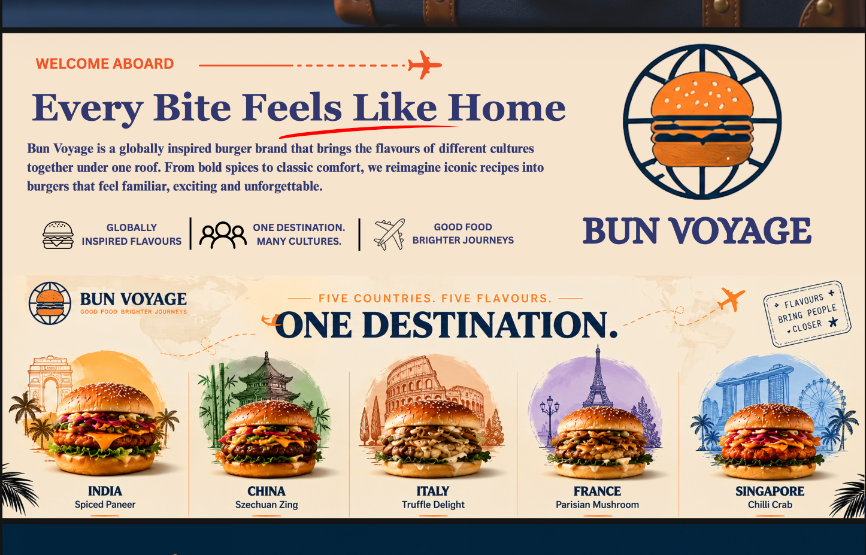
Spiced Paneer
Crisp marinated paneer slab infused with roasted cumin, garam masala, and fresh coriander-mint chutney. A high-protein vegetarian anchor.
Szechuan Zing
Crispy chicken thigh glazed in authentic Szechuan peppercorn chilli oil, pickled cabbage slaw, and toasted sesame crunch.
Truffle Delight
Seared gourmet patty layered with black truffle aioli, melted aged provolone, and crispy balsamic-glazed onions on a toasted brioche bun.
Parisian Mushroom
Slow-sautéed forest mushrooms, melted French Gruyère, and thyme-infused garlic Dijon butter; bistro sophistication in a burger format.
Chilli Crab Burger
Golden deep-fried soft-shell crab smothered in tangy, sweet-and-spicy egg-ribbon chilli crab gravy on a toasted mantou-style bun. The culinary tribute to the launch city.
From Fan Base to Buyer Base
Why marketing theory must replace marketing folklore.
In Chapter 1 of How Brands Grow, Professor Byron Sharp compares modern marketing executives to nineteenth-century doctors who enthusiastically practiced bloodletting for 2,500 years, operating on anecdotal intuition, orthodox folklore, and untested theories rather than empirical observation. When marketing managers sit down to plan a new brand launch, conventional textbooks instruct them to segment the audience, define a tiny hyper-targeted niche, craft an elaborate unique selling proposition (USP), and engineer intense customer loyalty.
Decades of empirical data collected by the Ehrenberg-Bass Institute across hundreds of categories and dozens of countries reveal that real consumer behaviour operates on very different laws:
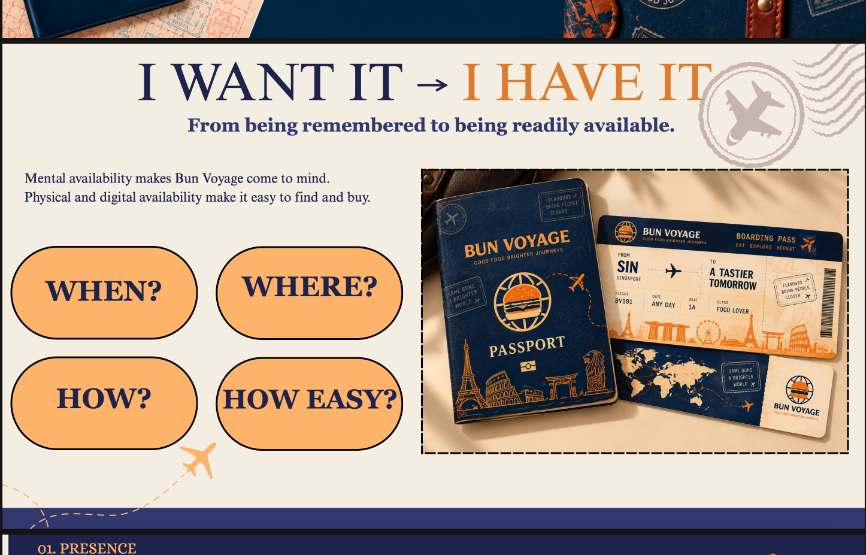
The Engine of Sustainable Brand Growth
Rather than attempting to lock buyers into an exclusive relationship, Bun Voyage models its market entry on a four-stage empirical sequence:
Grow the Brand, Not Just the Fan Base
Three clear choices: Who we reach, how we recruit trial, and where we compete.
To translate marketing science into actionable commercial planning, the Bun Voyage launch model establishes three strategic pillars. These pillars dictate where capital is allocated, which media channels receive investment, and how menu operations are structured.
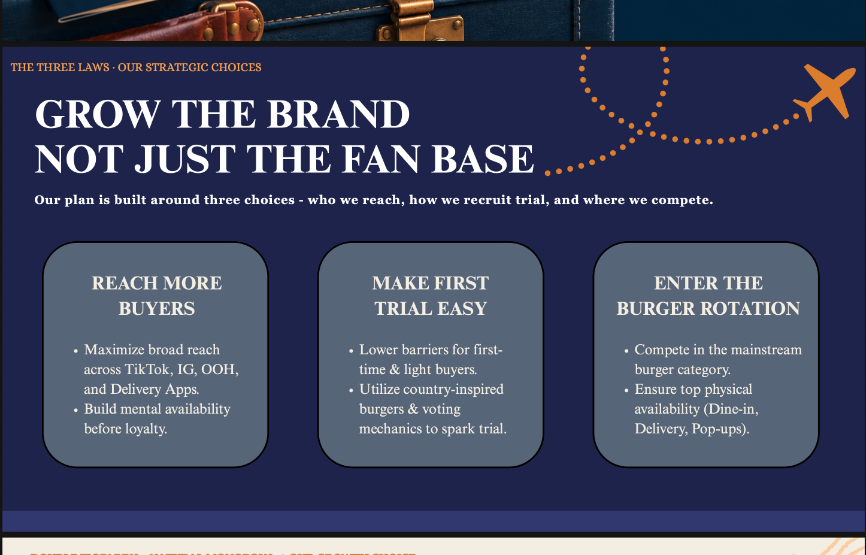
Reach More Buyers
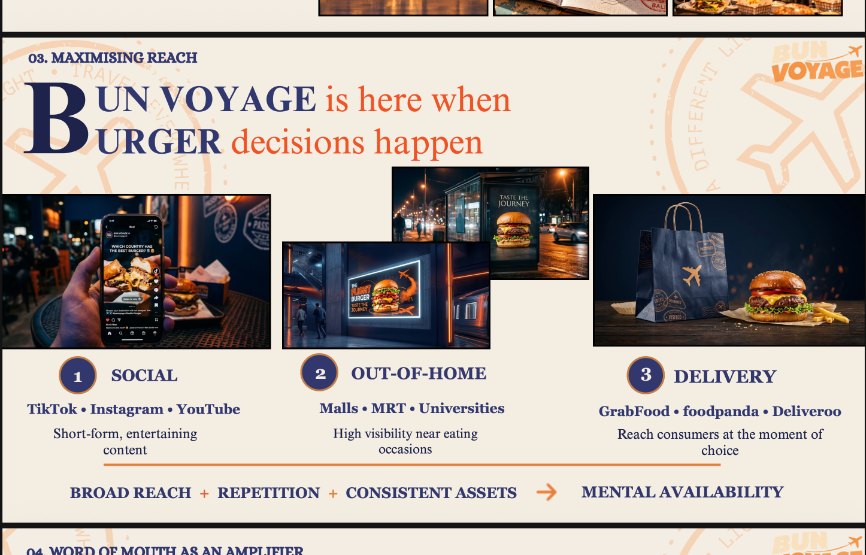
The goal is broad, cost-effective category reach rather than high-frequency targeting to a closed demographic. Bun Voyage plans exposure across transit hubs (MRT), high-traffic shopping malls, and digital channels (TikTok, Instagram, YouTube) to introduce distinct brand cues to all potential burger diners.
Make First Trial Easy
The primary hurdle for a new food brand is consumer hesitation. Bun Voyage lowers cognitive friction by offering a clear, 5-item signature menu, intuitive flavour descriptions, and introductory sampling flights (mini burger passport boxes) that reduce the psychological risk of ordering something unfamiliar.
Enter the Rotation
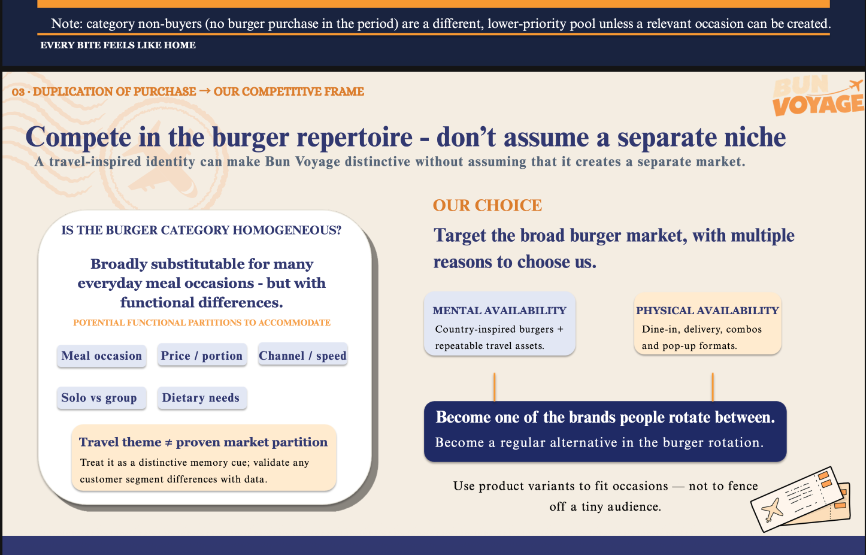
Consumers do not remain monogamous to one fast-food chain. Bun Voyage does not attempt to replace McDonald’s or KFC; it seeks to enter the consumer’s multi-brand consideration set. This requires broad channel presence across dine-in flagships, delivery aggregators, and express transit kiosks.
Win Broad Penetration Before Engineering Loyalty
The Heavy Buyer Fallacy and the reality of consumer purchase repertoires.
One of the most persistent myths in brand management is that marketing should concentrate primarily on "heavy buyers" or "brand loyals." Marketers routinely cite the Pareto Principle (the 80/20 rule), claiming that 20% of their buyers generate 80% of their sales. However, empirical studies across consumer packaged goods, fast-food, and services show that the heaviest 20% of buyers typically generate only about 50% of category volume; and more importantly, light buyers represent the overwhelming numerical majority of any brand’s customer base.
For a new entrant like Bun Voyage, obsessing over loyalty programs, app points, or repeat-purchase retention schemes before securing broad market penetration is commercially backwards. You cannot retain customers who have never heard of you, and you cannot build loyalty among consumers who have never tasted your food.
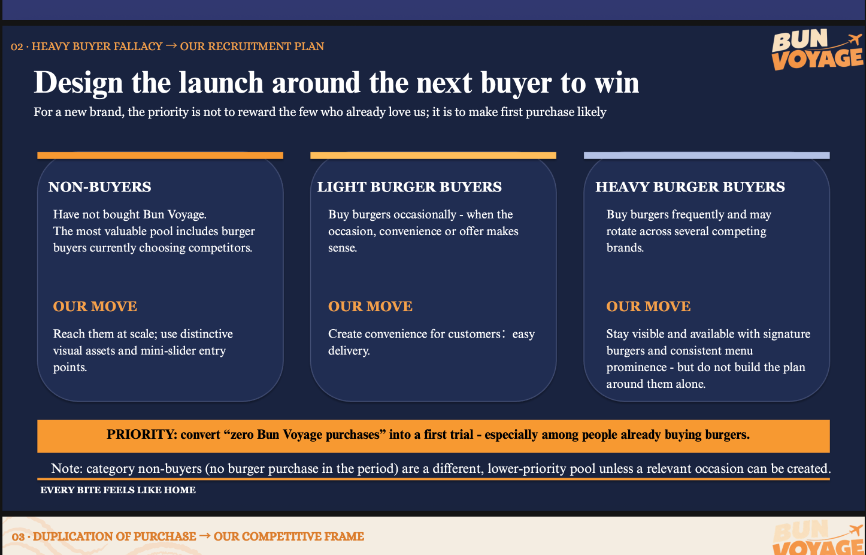
Category Non-Buyers
Individuals who do not buy quick-service burgers. In a launch phase, spending budget to convert these non-users is inefficient and expensive.
Light Burger Buyers
Diners who buy burgers only once a month or once a quarter. This is the largest pool of commercial revenue; recruiting them requires mental and physical ease.
Heavy Burger Buyers
Frequent diners who eat burgers weekly. They already rotate through 3 to 4 competing brands; Bun Voyage simply needs to enter their active consideration set.
The "Zero-to-One" Purchase Mandate
Bun Voyage’s go-to-market budget must not be diverted into complex loyalty app development, membership discounts, or VIP tiers. The entire strategic priority at launch must be the zero-to-one purchase: introducing the brand to thousands of light burger buyers across Singapore and making the initial trial purchase as natural, appealing, and friction-free as possible. Loyalty metrics will naturally follow penetration, as predicted by the Law of Double Jeopardy.
Understanding the Competitive Starting Point
Duplication of Purchase and the Singapore fast-food landscape.
When analyzing how consumers choose where to eat, marketing textbooks often claim that brands have distinct, loyal customer tribes; for instance, that “Shake Shack people” never visit McDonald's. In reality, the Duplication of Purchase Law demonstrates that competing brands share their customer base in direct proportion to the competitors’ market size. A Shake Shack buyer is virtually as likely to visit McDonald’s for a quick breakfast or lunch as any random fast-food diner.
To establish a realistic launch frame, Bun Voyage examined the Singapore Quick-Service Restaurant (QSR) environment using data from independent fast-food studies. Rather than treating these metrics as market share, the analysis strictly treats them as a competitive consideration proxy, evaluating the formidable baseline of category consideration that any newcomer must confront:
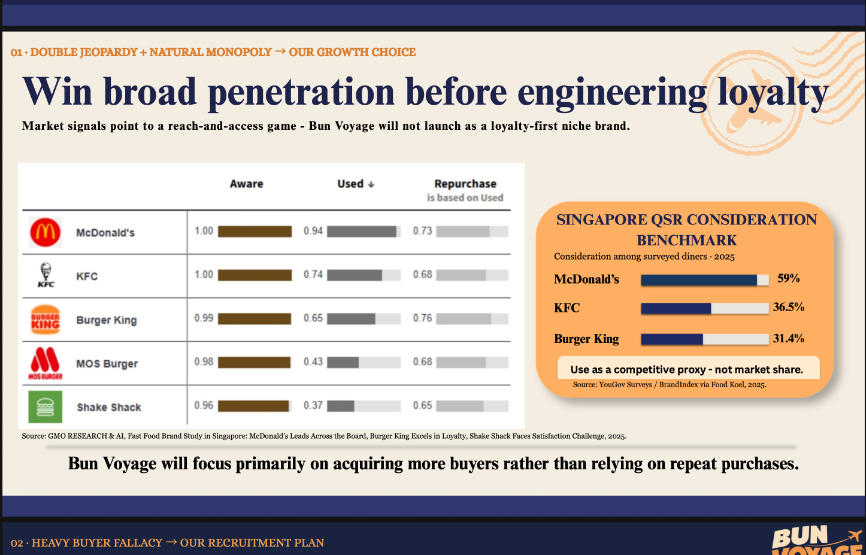
Singapore QSR Consideration Benchmark (2025)
COMPETITIVE PROXY DATAThe percentages listed above reflect consideration benchmarks among surveyed Singapore diners in 2025 (as cited in GMO Research & AI's Fast Food Brand Study in Singapore and YouGov BrandIndex via Food Kool). These figures represent stated consumer consideration: they are not retail sales volume or dollar market share. These benchmarks describe the incumbent competitive environment that Bun Voyage would enter, and do not represent metrics achieved by Bun Voyage itself.
Make Bun Voyage Easy to Recognise
Distinctive Brand Assets (DBAs) and Category Entry Points (CEPs).
In Chapter 2 and subsequent research from Jenni Romaniuk and Byron Sharp, the Ehrenberg-Bass Institute stresses that brands do not grow by convincing customers of profound philosophical differences. Consumers are distracted, busy people making split-second decisions. Advertising and branding work by refreshing and building mental structures that make the brand effortlessly identifiable at the moment of choice.
To accomplish this, a new brand must solve two complementary challenges:
- Mental Availability (CEPs): Linking the brand to the specific occasions, moods, and situations when people decide to buy food.
- Sensory Distinctiveness (DBAs): Equipping the brand with distinctive visual, physical, and verbal assets that stand out in cluttered digital feeds and physical streetscapes.
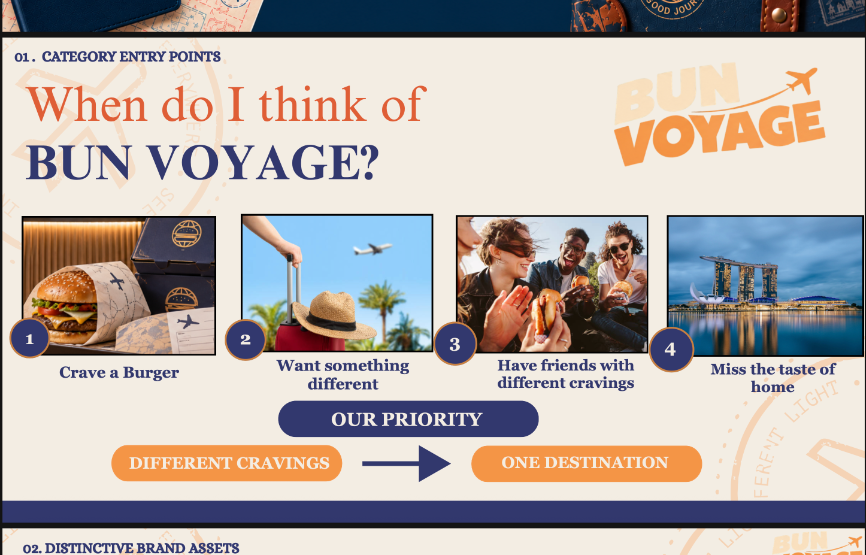
The 4 Buying Occasions (CEPs)
WHEN CONSUMERS THINK OF BUN VOYAGEThe primary category trigger: hunger for a substantial, savory, handheld meal. The baseline requirement that Bun Voyage must satisfy instantly without overcomplicating the experience.
Fast-food fatigue: bored of standard ketchup and cheese. Consumers want a new sensory experience (truffle aroma, tingling Szechuan chilli) while retaining burger comfort.
Social dining friction: one friend wants spicy Asian street food, another prefers European gourmet, and a third is vegetarian. Bun Voyage satisfies diverse palates in one order.
Nostalgic culinary longing: Singapore’s cosmopolitan population includes expatriates, global travelers, and locals seeking regional flavours (Chilli Crab, Spiced Paneer).
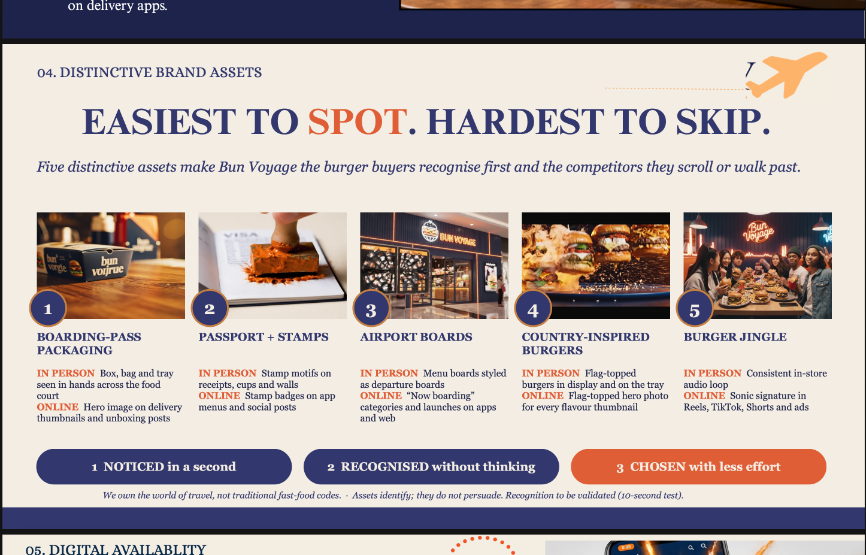
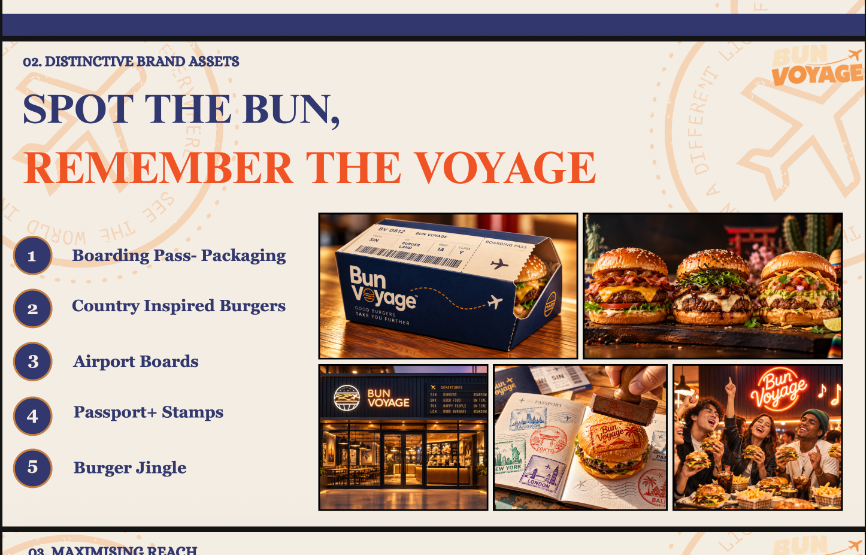
Candidate Distinctive Brand Assets
In brand science, design elements are only candidate assets until consumer research proves they possess high fame and uniqueness. Bun Voyage develops six candidate codes:
Burger wrapping paper styled like an airline boarding pass, with flight numbers, departure gates, and country flavour codes.
A pocket-sized physical tasting passport where customers receive an inked airport visa stamp every time they try a new country flavour.
Menu boards designed like mechanical airport flight information displays (FID), creating an unmistakable visual and auditory environment.
Deep aviation navy (#0B2340), warm parchment cream (#F7E6CF), and vibrant orange (#FF892B) forming a distinctive chromatic signature.
A clean silhouette icon merging a seeded sesame bun with longitudinal globe coordinates and a taking-off aircraft motif.
A subtle 3-tone airport public address chime preceding order ready notifications and digital audio adverts.
From Strategic Choices to Market Action
The proposed three-stage rollout and physical distribution strategy.
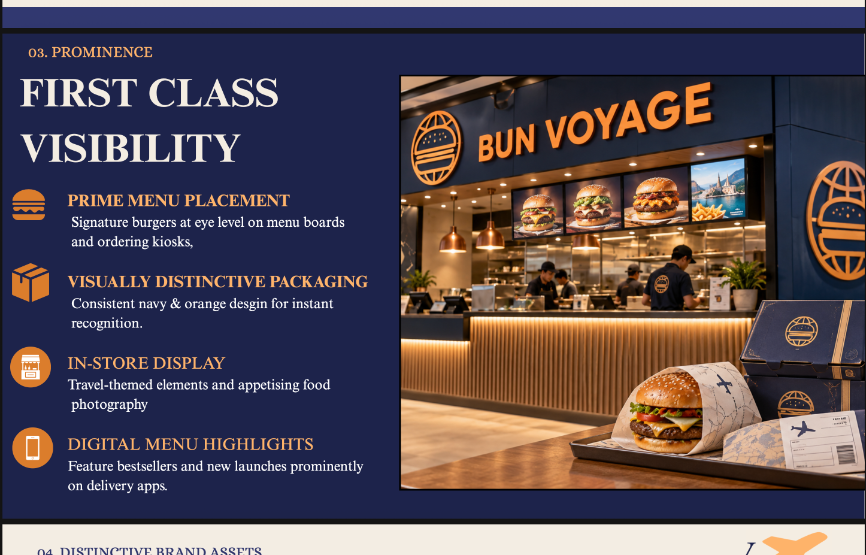
A strategy is only as robust as its physical execution. To achieve physical availability, a brand must be accessible where people live, work, transit, and scroll. Bun Voyage maps its market introduction across three structured phases: building foundational assets, generating broad initial reach and trial, and expanding physical and digital availability across Singapore.
The Proposed 3-Stage Launch Roadmap
Build the Foundations
Finalise the core brand style guide, food safety specifications, and distinctive packaging assets (boarding pass wraps, passport stamp cards, and luggage-tag receipts). Establish initial supply contracts for specialty regional ingredients (fresh paneer, black truffle oil, Szechuan peppercorns). Integrate the digital web hub at bunvoyage.com and audit aggregator delivery APIs.
Create Broad Reach and Trial
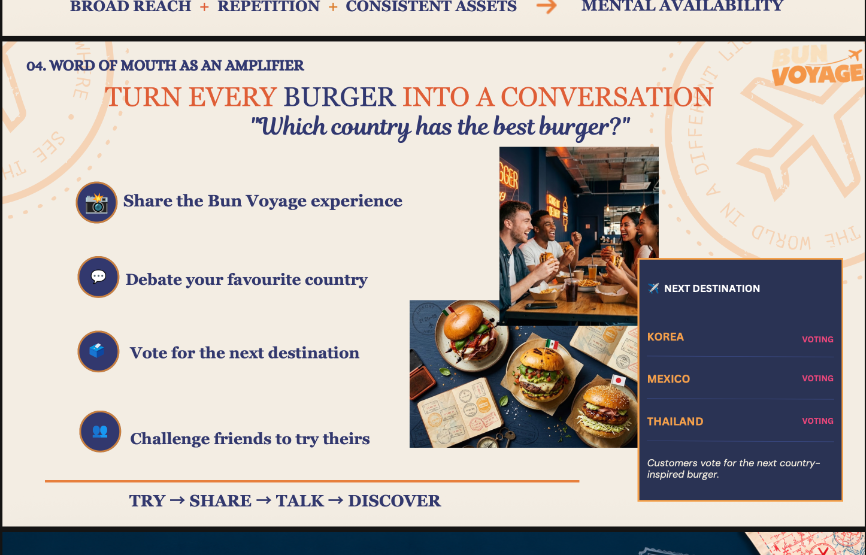
Launch mass-reach out-of-home (OOH) media across key MRT stations and shopping malls. Ignite organic social amplification with the campaign: “Which country has the best burger?”, inviting diners to debate and vote on their favorite national recipe. Deploy mobile pop-up sampling flights in central business plazas and university campuses to generate frictionless first-time product trial.
Learn and Expand Footprint
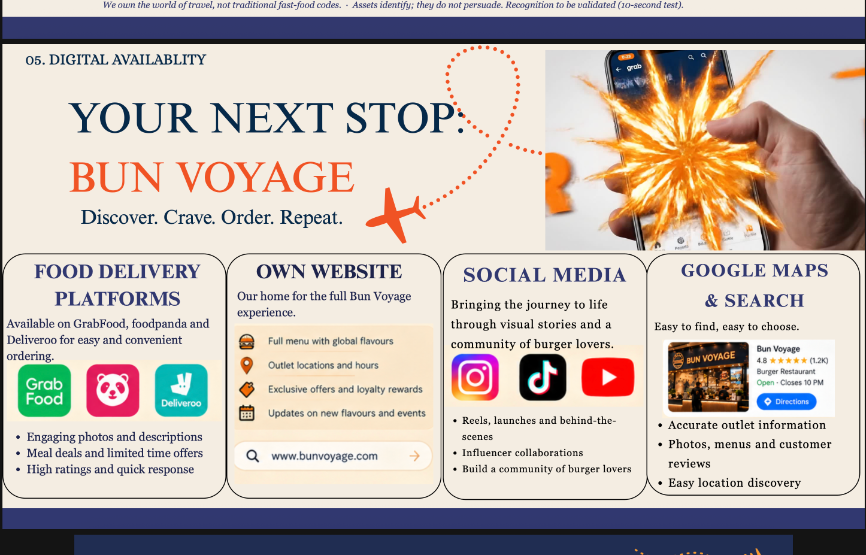
Scale physical locations across high-density Singapore hubs based on delivery heatmaps and footfall data. Monitor operational throughput, order accuracy, and packaging integrity. Establish an “always-on” media presence that maintains baseline mental availability, avoiding the catastrophic post-launch silence that causes new brands to fade from memory.
Proposed Singapore Launch Nodes
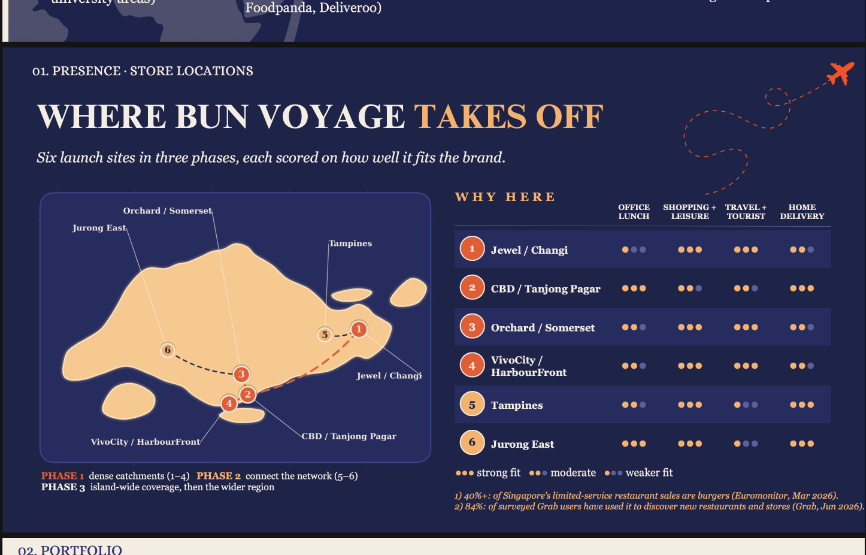
To maximize physical availability, the retail plan distributes outlets across complementary consumer traffic flows:
Global travelers, transit tourists, and local weekend visitors. Direct contextual harmony with the aviation travel theme.
High-density office professionals seeking fast, high-quality midday dining and rapid desk delivery.
High weekend footfall among youth, trendsetters, and leisure shoppers exploring new culinary concepts.
Massive retail hub and transit gateway to Sentosa; high family leisure and group dining volume.
Dense eastern residential center and regional MRT interchange; essential for high delivery density.
Major commercial and residential hub in western Singapore; captures university students and heartland diners.
What Would Growth Look Like?
The Flight Plan: Moving from a new name to an everyday category choice.
In conventional corporate planning, success is frequently assessed through vanity metrics (social media follower counts, click-through rates, brand sentiment scores) that bear zero correlation to long-term commercial performance. As Byron Sharp demonstrates in How Brands Grow, brand loyalty metrics naturally reflect a brand's size rather than any mystical emotional bond.
The Bun Voyage measurement architecture is organized around The Flight Plan: a three-move framework designed to diagnose market progress across four concrete, empirical dimensions:
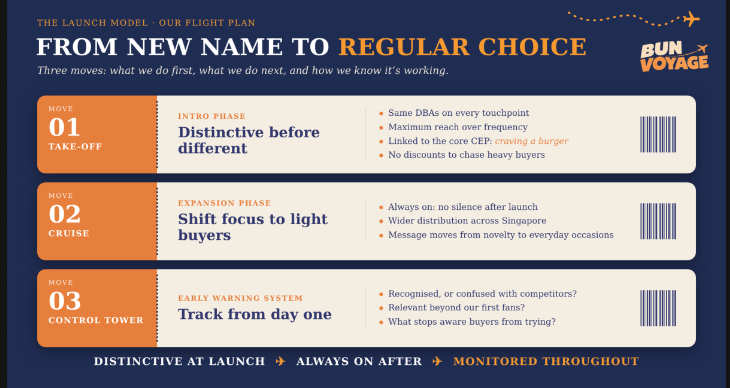
Distinctive Before Different
- Deploy identical distinctive brand assets (DBAs) on every single touchpoint.
- Prioritise maximum reach over high advertising frequency.
- Anchor messaging firmly to the core CEP: “craving a burger.”
- Refuse deep price discounting that attracts unprofitable promo-chasers.
Shift Focus to Light Buyers
- Maintain an “always-on” media presence with no post-launch silence.
- Expand delivery and physical distribution corridors across Singapore.
- Transition communication from novelty trial to everyday dining occasions.
- Preserve asset memory structures across seasonal menus.
Track from Day One
- Is the brand recognised, or frequently confused with competitors?
- Does interest expand beyond initial food bloggers and early fans?
- What friction stops consumers who know the brand from actually buying?
- Are repeat rates matching category Double Jeopardy benchmarks?
Proposed Evaluation Framework
Mental Availability Measures
Evaluates spontaneous brand salience and memory structures: unprompted brand recall, prompted recognition in the burger category, recognition score of distinctive assets (boarding pass wrap, departure board), and association breadth across the four Category Entry Points.
Trial & Penetration Measures
Tracks customer recruitment: total unique buyer count across each 30-day period, proportion of first-time trialists, trial conversion rate from sampling kiosks, and the ratio of occasional light buyers to repeat patrons (monitoring healthy Double Jeopardy distribution).
Physical & Digital Availability Measures
Measures purchase friction: percentage of Singapore residential and commercial zones covered within a 30-minute delivery radius on GrabFood/foodpanda, shelf prominence score on delivery app category carousels, menu discoverability rank, and app cart abandonment rates.
Commercial & Repertoire Measures
Commercial health indicators: daily order volume per store, average order value (AOV), repeat purchase interval, contribution margin per transaction, and repertoire duplication rates against major QSR incumbents (measuring true category entry).
What This Project Taught Me About Brand Growth
Connecting creative intuition with empirical commercial strategy.
When I first conceived Bun Voyage, my thinking began where most creative marketing students start: with the sensory allure of the product. The idea of five country-inspired burgers (spiced paneer, tingling Szechuan chicken, black truffle provolone, French mushroom Gruyère, and local Singapore chilli crab) felt inherently exciting. I envisioned travel boarding passes, passport stamps, and a brand world that felt like an airport departure lounge.
However, immersing myself in Byron Sharp's How Brands Grow forced a profound intellectual pivot. The literature revealed that great creative concepts fail every single day not because their recipes are poor or their logos are uninspired, but because their founders confuse creativity with commercial mechanics. A brand does not survive on the admiration of a handful of passionate foodies. It survives by building mental availability among millions of distracted, occasional buyers and ensuring that when those buyers feel a hunger pang, purchasing the brand requires minimal physical, cognitive, or financial effort.
Bun Voyage became an exercise in balancing these two vital disciplines: using rich, travel-inspired storytelling to give the brand a joyful soul, while anchoring its launch in the unforgiving, evidence-based laws of penetration, distinctiveness, and availability.
“Creating a brand people can love is one challenge. Building a brand that more people can notice, remember, find, and buy is a different one. Bun Voyage was my opportunity to think about both.”
References & Literature Foundation
ACADEMIC & MARKET CITATIONS- Sharp, Byron (2010). How Brands Grow: What Marketers Don't Know. Oxford University Press. (Key foundations: Double Jeopardy Law, Duplication of Purchase Law, mental and physical availability, light buyer recruitment, the Heavy Buyer Fallacy).
- Romaniuk, Jenni & Sharp, Byron (2016). How Brands Grow: Part 2. Oxford University Press. (Category Entry Points framework, mental availability metrics, emerging market growth).
- Romaniuk, Jenni (2018). Building Distinctive Brand Assets. Oxford University Press. (Asset taxonomy, Fame and Uniqueness matrix, sensory brand codes).
- Ehrenberg, Andrew S. C. (1988). Repeat-Buying: Facts, Theory and Applications. Charles Griffin & Co. (Empirical Dirichlet models, stochastic brand choice).
- GMO Research & AI (2025). Fast Food Brand Study in Singapore. Independent consumer survey evaluating brand awareness, consideration, and frequency benchmarks across Singapore quick-service restaurant diners.
- YouGov Surveys / BrandIndex via Food Kool (2025). Singapore QSR Consideration Rankings. Consumer consideration proxies for leading quick-service dining chains in Singapore (McDonald's 59.0%, KFC 36.5%, Burger King 31.4%).

Brand strategist and luxury marketing candidate at ESSEC Business School Singapore. Researching empirical marketing science, Category Entry Points, brand revitalisation, and digital-physical retail experiences.
