
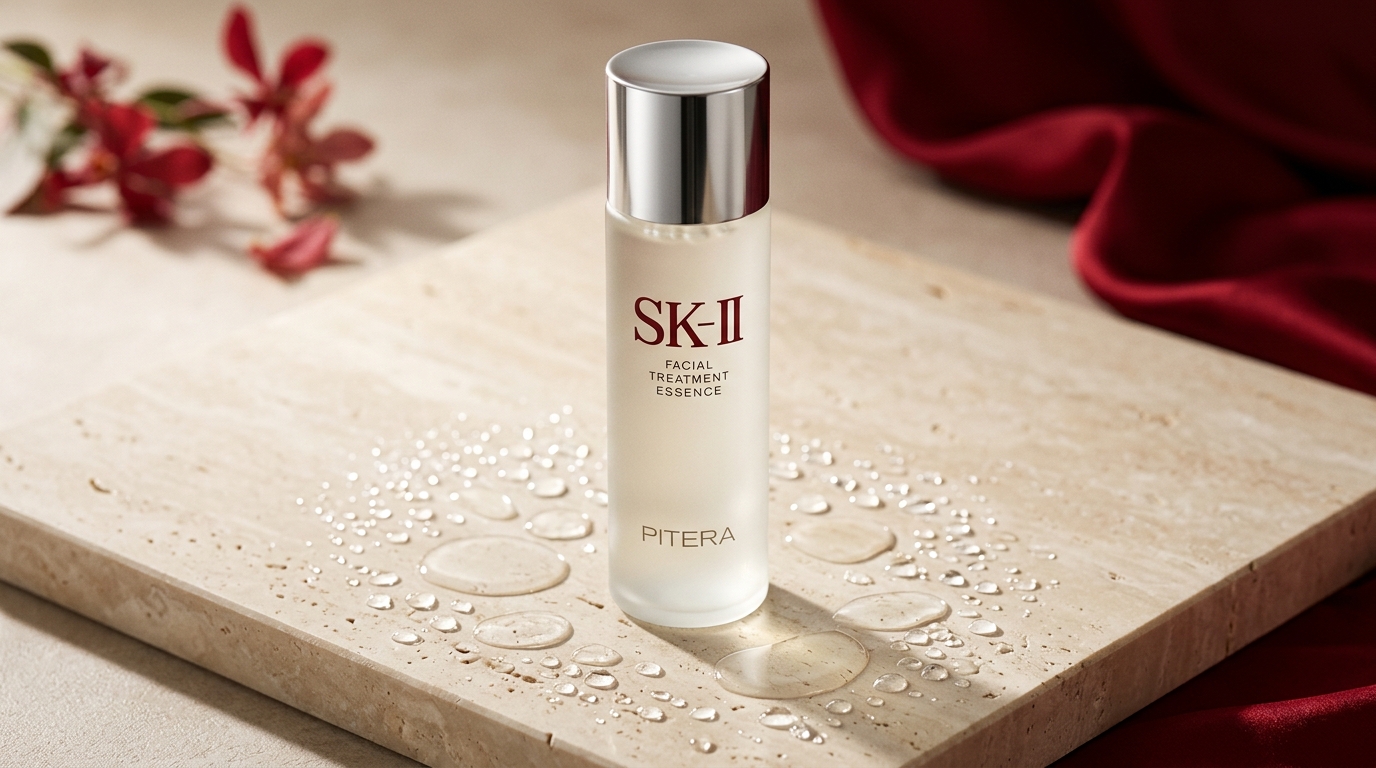
Sometimes, getting back in the game requires questioning the very assumptions that made a brand successful in the first place.
When Helene Bellamy, Senior Vice President of Global SK-II and Asia Skin Care Upstream Innovation at Procter & Gamble, walked into our lecture hall at ESSEC in Singapore, I expected a masterclass on creative prestige advertising. Like most marketing students, I assumed luxury revitalisation was about casting bigger celebrity ambassadors, staging splashier pop-ups in Tokyo, or producing cinematic campaign films.
Within fifteen minutes, the conversation radically dismantled that assumption.
Instead of discussing promotional flair, we found ourselves interrogating the fundamental physics of consumer behaviour. Why does a consumer who instantly recognises SK-II walk past its boutique counter to buy a competing serum? Does universal brand awareness translate into buying consideration? What happens when duty-free travel channels, cross-border resale networks, and domestic digital algorithms completely rewrite the rules of discovery?
That dialogue stayed with me long after the session concluded. It prompted me to look beyond brand anecdotes and examine SK-II through the lens of empirical marketing science: the Ehrenberg-Bass Institute’s frameworks of Category Entry Points (CEPs), Distinctive Brand Assets, and Mental Availability.
What Does It Actually Mean to "Get Back in the Game"?
The central premise framed during our session was simple yet provocative: my recollection of the discussion was that the speaker touched upon SK-II’s historical trajectory, where peak global brand revenue had approached roughly $2 billion before experiencing a severe contraction down toward $1 billion in subsequent cycles. This dramatic commercial reality was raised to challenge our cohort: If you were leading this brand, how would you engineer the path back?
Important Distinction: In Procter & Gamble’s audited public filings (SEC Form 10-K), standalone brand revenues for individual assets like SK-II are not broken out line-by-line; P&G reports aggregated segment net sales for its overall Beauty segment ($15.1B–$16.0B annually). Industry market research estimates and analyst reports historically estimated SK-II’s peak pre-pandemic global sales at approximately $2 billion, before headwinds hit. Therefore, the $2B to $1B figure must be treated strictly as an unverified session note / illustrative management proxy, rather than an audited SEC financial metric.
Crucially, a financial revenue decline does not automatically mean a brand has lost its equity, awareness, or identity. In P&G’s recent earnings disclosures, CFO Andre Schulten and CEO Jon Moeller acknowledged that SK-II faced sharp, localized double-digit headwinds, including a reported 34% drop in Greater China in late 2023, driven by an intersection of external forces:
- Travel Retail & Daigou Crackdowns: Tightened customs regulations and Hainan duty-free price controls curtailed grey-market reseller margins.
- Geopolitical & Social Sentiment: Anti-Japanese consumer sentiment in mainland China sparked by the Fukushima treated wastewater release in late 2023 caused temporary boycotts of Japanese manufactured prestige cosmetics.
- Macroeconomic Softening & Ingredient Dupes: A softening Chinese consumer luxury market coincided with aggressive domestic "C-beauty" players marketing fermented Galactomyces "dupes" at one-tenth of SK-II’s price point.
The strategic challenge, therefore, is not rebuilding a broken brand from scratch. It is separating cyclical commercial headwinds from structural consumer relevance. To get back in the game, SK-II must become relevant in more of the everyday moments that prompt people to purchase premium skincare.
The Moments When Consumers Enter the Category
In marketing literature, brand awareness is frequently treated as a binary checklist: does the customer know your name? But as Professor Jenni Romaniuk and Professor Byron Sharp at the Ehrenberg-Bass Institute have proven through decades of empirical data, general awareness is insufficient. What drives commercial brand growth is Mental Availability: the propensity of a brand to be noticed or thought of in buying situations.
Mental availability is built upon Category Entry Points (CEPs). CEPs are the internal and external cues that prompt a consumer to access a product category. They answer the questions: Why, When, Where, With Whom, and With What is this category being purchased?
Skin Texture Fatigue
“My skin feels rough, bumpy, or uneven under makeup and needs immediate micro-exfoliation and smoothing.”
Historic SK-II StrengthMilestone Event Prep
“Preparing for a wedding, graduation, or gala where camera-ready, glass-skin radiance is non-negotiable.”
High Consideration CuePost-Travel Recovery
“Dehydrated and stressed skin following long-haul cabin flights or severe seasonal weather shifts.”
Under-leveraged CueBarrier Replenishment
“Over-exfoliated skin barrier suffering from harsh retinols, requiring non-comedogenic bio-ferment hydration.”
Emerging Gen Z NeedPrestige Gifting
“Lunar New Year, Mother’s Day, or anniversary gift communicating respect, status, and luxury reverence.”
High Volume OccasionPreventative Anti-Aging
“Investing in early 20s pre-juvenation before visible fine lines set in, wanting clinical longevity.”
Strategic Battleground*Illustrative skincare need states derived from category consumer behaviour studies, not internal P&G proprietary rankings.
If a consumer thinks of SK-II only during high-stakes gifting seasons or when they are in their 40s worrying about visible aging, the brand is mathematically excluded from 80% of daily skincare purchase occasions. Brand growth is not merely about reaching new people; it is about widening the portfolio of category cues that trigger SK-II in the consumer’s memory. If SK-II links PITERA to post-sun recovery, pre-makeup skin priming, and hydration fatigue, it dramatically expands its mental footprint without altering its prestige formulation.
Being Recognisable Is Only the Beginning
In Building Distinctive Brand Assets, Professor Jenni Romaniuk distinguishes between three critical concepts that are often conflated in agency presentations:
A consumer can identify the brand when the logo or name is explicitly presented.
Cues (colors, bottle shapes, sounds) that identify the brand even without the brand name.
The likelihood of the brand coming to mind in relevant purchase situations.
A brand can have high recognition but weak distinctiveness. Or high distinctiveness in a museum sense, but low mental availability when a customer opens a beauty app on their phone.
Cylindrical Glass Bottle
High fame, high uniqueness. Unmistakable weight and laboratory minimalism.
Crimson / Burgundy Red
Deep Pantone red cue. Immediately signals prestige gifting and Japanese heritage.
The PITERA™ Moniker
Proprietary trademark ingredient. Functions as both technical justification and identity code.
Clear Water Texture
Unlike viscous creams or silicone serums, the watery patting ritual is distinctly sensory.
When designing new digital advertising or social campaigns, SK-II should never sacrifice its core assets - the frosted cylindrical silhouette, the deep crimson red, the signature water patting sound - for the sake of novelty. New campaigns must reinforce these assets while connecting them to new category entry points.
The Power of Owning Something Distinctive
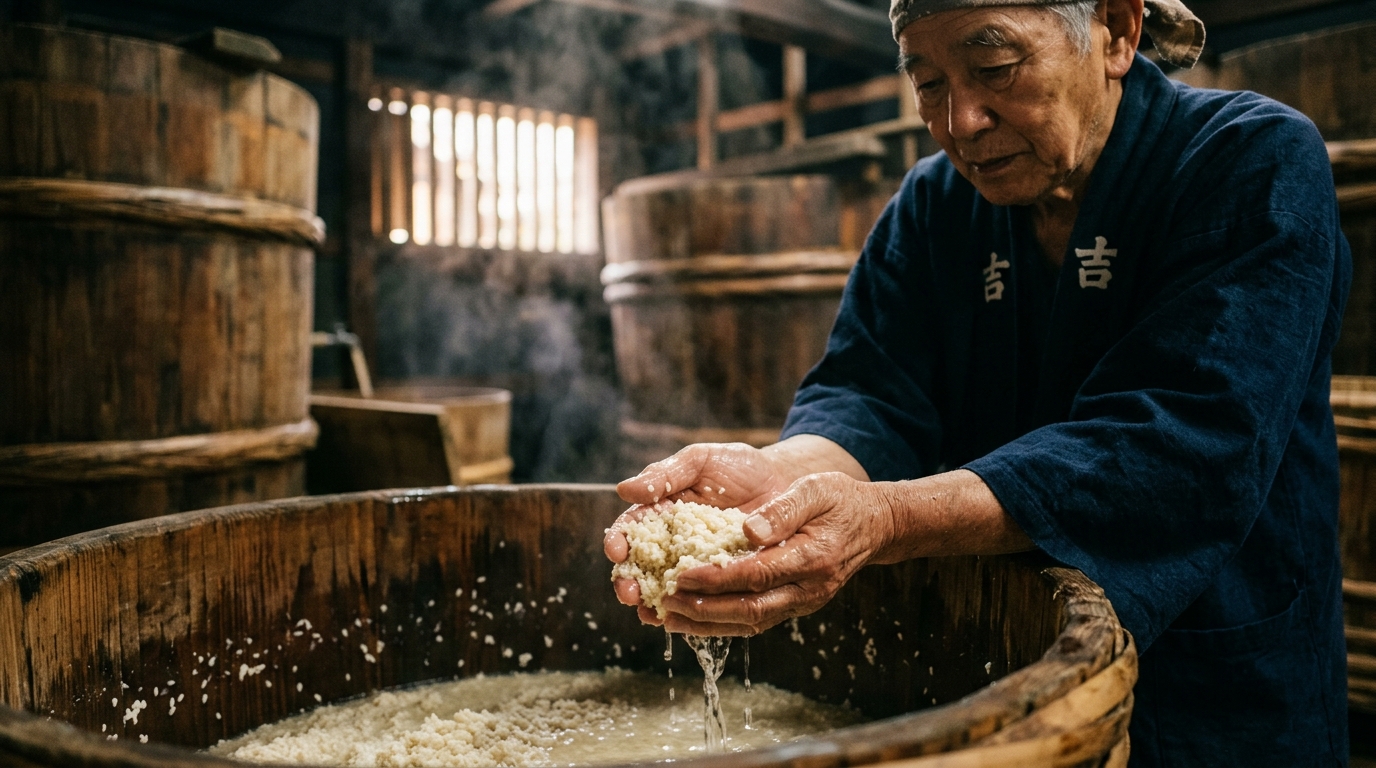
Scientists observed that elderly sake brewers in Japan possessed remarkably smooth, line-free hands from constant immersion in fermenting yeast mash.
Every iconic luxury brand requires a foundational myth that bridges nature, human craft, and scientific validation. For SK-II, that foundation is PITERA™.
In the 1970s, Japanese skincare scientists visiting a traditional sake brewery observed an unexpected physiological anomaly: while the master brewers (Toji) had wrinkled, sun-weathered faces, their hands were remarkably youthful, supple, and unlined. Research into 350 yeast strains culminated in the isolation of a proprietary yeast strain - yielding the bio-fermentation liquid known scientifically as Galactomyces Ferment Filtrate.
Acquired by Procter & Gamble through its purchase of Max Factor in 1991, SK-II built its entire prestige global empire around this bio-ferment. In verified public interviews, including an exclusive dialogue with ELLE, Helene Bellamy highlighted what holds the brand together after four decades:
“What holds SK-II together after 45 years is the power of unwavering consistency. We don’t chase transient cosmetic fads or alter the core formula of Facial Treatment Essence. Instead, our scientific upstream innovation focuses on deepening our understanding of what PITERA™ actually does for the skin.”
As a marketing strategist, it is critical to distinguish between marketing storytelling and clinical claims. Independent dermatological literature establishes that Galactomyces Ferment Filtrate is rich in amino acids, peptides, vitamins, minerals, and organic acids that closely mimic the skin’s Natural Moisturizing Factors (NMF), supporting stratum corneum hydration and antioxidant protection. However, rigorous marketing analysis must avoid making unsubstantiated medical claims: PITERA™ is a cosmetic bio-ferment, not a pharmaceutical anti-aging drug. Its strength lies in sensory efficacy, skin condition improvement, and deep emotional resonance.
The Consumer Has Changed. Has the Strategy?
During our campus session, Helene Bellamy emphasized that brands get into trouble when legacy assumptions remain unexamined. A distribution channel or consumer segment that drove exponential growth for ten years can quickly become an anchor when macro realities shift.
Here are five critical hypotheses worth testing:
Assuming Daigou & Duty-Free Volume Equals Domestic Consumer Loyalty
Why it must be questioned: Much of the historical volume recorded in travel retail was driven by arbitrage resellers (Daigou) reselling to price-sensitive Chinese consumers at steep discounts. When customs tightened, true organic domestic demand was exposed as lower than assumed.
Assuming 20-Somethings Discover Skincare Through Department Store Beauty Counters
Why it must be questioned: Gen Z skincare consumers in Seoul, Tokyo, and Shanghai discover products via algorithm-curated short video (Douyin, TikTok, Xiaohongshu) and dermatologist "ingredient-check" influencers. Traditional glass counters feel intimidating and formal.
Assuming Heritage Storytelling Alone Defeats Clinical Ingredient "Dupes"
Why it must be questioned: Mass-market brands can easily list "Galactomyces" on their labels for $20. If SK-II only communicates that PITERA is yeast, consumers perceive parity.
One Brand, Different Consumer Contexts
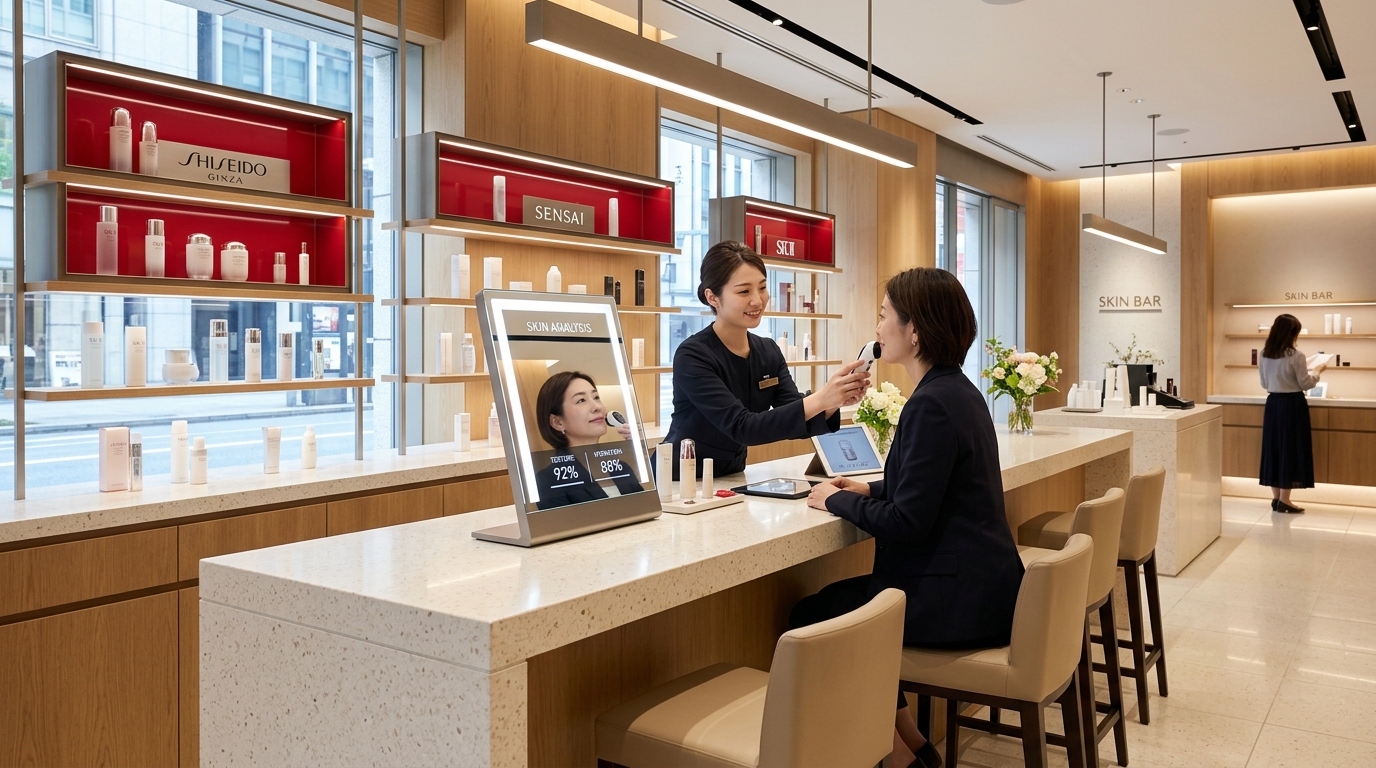
In flagship locations, digital skin diagnosis mirrors and personalized bio-metric consultations merge scientific precision with luxury hospitality.
During the guest session, Helene Bellamy explored how SK-II navigates three distinct Northeast Asian markets: China, Japan, and Korea. While Western executives frequently speak of "Asia" as a monolith, the consumer discovery journeys, channel dynamics, and competitive environments could not be more divergent.
| DIMENSION | CHINA (GREATER CHINA) | JAPAN (DOMESTIC HOME) | SOUTH KOREA |
|---|---|---|---|
| Market Positioning | Ultra-prestige status symbol, aspirational gifting, and digital social proof. | Trusted heritage staple, multi-generational loyalty, daily foundational ritual. | Premium functional bio-ferment competing against hyper-innovative K-beauty. |
| Primary Channels | Xiaohongshu (RED), Tmall Flagship, Douyin Live-streaming, Hainan Travel Retail. | Department stores (Isetan, Mitsukoshi), premium drugstores, Ginza flagships. | Olive Young prestige tier, duty-free salons, direct medical aesthetics clinics. |
| Key Headwinds | Post-Fukushima sentiment, aggressive domestic C-beauty dupes, price discount friction. | Aging customer base; recruiting younger 20-somethings without alienating loyalists. | Rapid 6-month product cycle competition and intense serum/ampoule layering habits. |
| Core Relevant CEPs | Pre-wedding radiant glass skin, high-status Lunar New Year gifting. | Lifelong skin texture refinement, daily gentle hydration, post-cleansing tonic. | Post-aesthetic treatment soothing, barrier repair, multi-step glass complexion. |
| Strategic Mandate | Reassure Japanese manufacturing purity, enforce strict price discipline, leverage ambassadors like Eileen Gu. | Modernize boutique consultation with AI skin diagnostics; celebrate craftsmanship heritage. | Position PITERA as an essential high-potency foundation step that amplifies K-beauty regimens. |
From Brand Heritage to Renewed Relevance: A 5-Workstream Roadmap
Drawing upon the session dialogue and independent research, I developed a practical, evidence-informed framework for how SK-II can systematically rebuild its commercial and brand momentum:
Diagnose the Problem Before Prescribing the Creative Solution
A revenue decline cannot explain itself. Marketers must audit whether the shortfall is driven by physical availability (out-of-stocks, closed counters, duty-free disruption) or mental availability (fewer buying situations thought of). SK-II must conduct deep customer path-to-purchase audits in China, Japan, and Korea before launching new advertising campaigns.
Map and Re-anchor Category Entry Points
Commission empirical research to identify the fastest-growing skincare purchase cues among consumers aged 22–35. Audit SK-II’s current association scores against these cues. Develop distinct creative communication modules linking PITERA to daily texture fatigue, post-sun restoration, and seasonal transition, moving beyond the legacy "aging fear" paradigm.
Enforce Distinctive Brand Asset Discipline Across All Touchpoints
Codify the brand’s sensory cues into an unshakeable design system: the frosted glass flacon, the crimson red hue, the typographic PITERA mark, and the sound of the liquid patting ritual. Ensure that within 1.5 seconds of viewing any TikTok, Instagram, or Xiaohongshu video, the consumer subconsciously knows it is SK-II, even on mute.
Reassess Consumers & Reclaim Pricing Integrity
Eliminate excessive secondary-market discounting that erodes luxury perception. Re-invest margin into experiential counter clienteling, high-touch consultation bars, and authenticated direct-to-consumer loyalty programs. Meet consumers on their native digital platforms with educational, dermatologist-partnered storytelling.
Build a Two-Tier Measurement System: Diagnostics vs Business Outcomes
Separate short-term leading diagnostic indicators from long-term business outcomes to avoid premature strategy abandonment:
- Distinctive asset fame & uniqueness scores
- Category Entry Point mental association share
- Organic search volume for "PITERA benefits"
- Digital counter booking conversion rate
- New customer acquisition rate (aged 20–35)
- Customer lifetime value & repurchase rate
- Full-price gross margin contribution
- Organic sales growth across Asia hubs
How Do You Evolve Without Losing What Makes You SK-II?
Every historic luxury maison eventually confronts an existential strategic paradox: How do you stay fresh and relevant without destroying the distinctive heritage that created your value in the first place?
When brands panic after revenue drops, their instinctive reaction is often reckless reinvention: changing packaging, reformulating products, lowering prices, or hopping onto micro-trends that alienate loyal customers.
SK-II’s superpower is precisely that it has not mutated its core. The Facial Treatment Essence formulation remains virtually identical to the original discovery from 1980. That is an astonishing competitive moat in an industry notorious for ephemeral product cycles.
The solution to the tension between consistency and change is architectural:
- The PITERA™ fermentation formula
- The frosted glass cylindrical flacon
- The crimson red visual identity and logo
- The commitment to Japanese craftsmanship and scientific rigor
- The Category Entry Points highlighted in storytelling
- Cultural ambassador alignments (e.g. Eileen Gu)
- Digital diagnostic tools (AI skin analysis mirrors)
- Algorithmic content distribution and retail clienteling
By keeping the core immutable and the communication envelope flexible, SK-II honors its 45-year pedigree while meeting a new generation on their own terms.
What I Took Away From the Session
Listening to Helene Bellamy in our ESSEC cohort in Singapore was a defining moment in my graduate marketing education. It bridged the sterile equations of business school textbooks with the messy, high-stakes realities of managing an Asian luxury powerhouse inside the world’s largest consumer goods company.
My five deepest personal takeaways:
Awareness is vanity; Mental Availability is sanity. Consumers do not buy brands simply because they know their names. They buy brands that spontaneously emerge in memory during specific need situations.
Distinctive brand assets are an insurance policy. In an era of infinite scroll and algorithm fatigue, owning recognizable cues that work in under two seconds is the difference between brand building and wasting media spend.
Heritage is an amplifier, not an excuse. A four-decade-old formulation is only valuable if it solves a real consumer concern today. Heritage without modern relevance is just history.
Never mistake a channel trend for consumer desire. Gray-market arbitrage and travel retail booms can mask underlying demand weakness. True health is measured by domestic full-price trial and repurchase.
Getting back in the game starts with diagnosis. Great leaders don’t rush to launch a frantic ad campaign when numbers dip. They pause, audit consumer reality, and systematically rebuild relevance from the ground up.
I am deeply grateful to Helene Bellamy for her candor, strategic generosity, and intellectual rigor during our session. The discussion demonstrated what high-level brand strategy truly looks like: quiet confidence, empirical discipline, and the courage to ask hard questions when the rules of the game change.
References & Secondary Literature
Romaniuk, J., & Sharp, B. (2016). Building Distinctive Brand Assets. Oxford University Press / Ehrenberg-Bass Institute for Marketing Science.
Sharp, B. (2010). How Brands Grow: What Marketers Don't Know. Oxford University Press.
Romaniuk, J. (2018). Better Brand Health: Measuring Category Entry Points and Mental Availability. Ehrenberg-Bass Institute.
Procter & Gamble Co. (2024). Annual Report on Form 10-K for the Fiscal Year Ended June 30, 2024. U.S. Securities and Exchange Commission (SEC).
Schulten, A. (CFO) & Moeller, J. (CEO). (2023–2024). P&G Quarterly Earnings Call Transcripts (Q1, Q2 FY24). Highlighting SK-II Greater China headwinds, anti-Japanese sentiment, and Travel Retail impacts.
Bellamy, H. (SVP, Global SK-II, P&G). (2024). Exclusive Interview: "What Still Holds SK-II Together After 45 Years?". ELLE India.
Procter & Gamble / SK-II. (September 2024). "Global Prestige Skincare Brand SK-II Welcomes World Champion Freeskier Eileen Gu as New Global Brand Ambassador". PR Newswire.
Business of Fashion (BoF). (2023–2024). Prestige Beauty in China: Navigating the New Luxury Consumer and C-Beauty Rivalry.
CosmeticsDesign-Asia. (2024). Japanese Beauty in China: Rebuilding Consumer Confidence Post-Wastewater Boycotts.
Bloomberg Intelligence. (2024). Procter & Gamble Beauty Segment Outlook & Asian Prestige Market Dynamics.
Explore More Work
Inside Miu Miu: Retail, Clienteling & Brand Strategy →
Lynn Chou (Managing Director, Miu Miu Singapore) on boutique ground realities, customer data, and Prada Group differentiation.
Bun Voyage: Building a Burger Brand with the Laws of Growth →
Applying Byron Sharp's empirical brand growth principles, Category Entry Points, distinctive brand assets, and spatial rollout to a QSR brand launch.