
The Question Behind Luxury's Next Chapter
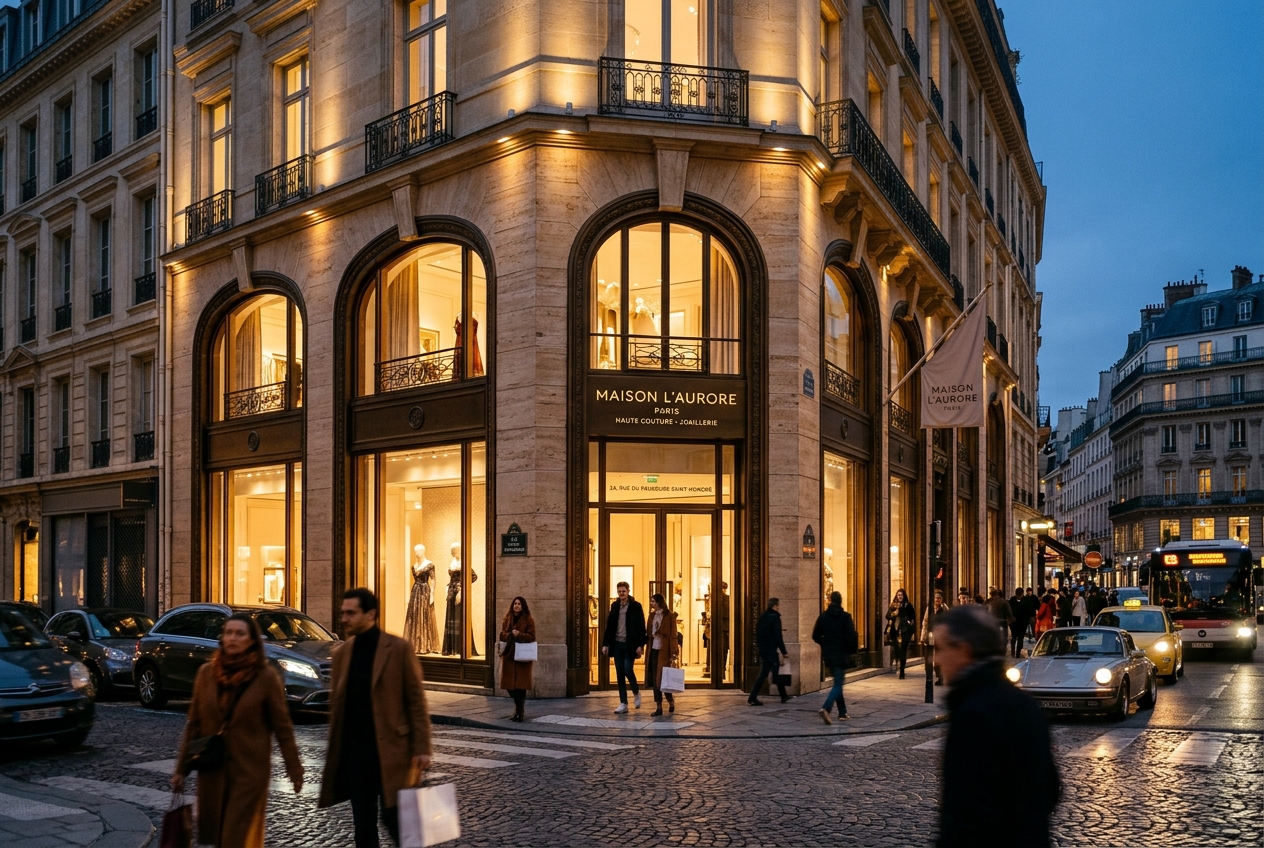
A luxury store is never just a beautiful address. It is a multi-million-euro capital commitment, an explicit selection of which customer segment to pursue, an intricate distribution choice, and the physical manifestation of a Maison's creative soul. When an executive stands before a floor plan or a lease contract in Paris, Tokyo, or Singapore, they are not evaluating square meters in isolation; they are deciding how their brand will live in the real world.
Yet today, the luxury industry is navigating a fundamental market reset. After the extraordinary post-pandemic rebound of 2021–2023, the sector faces softer boutique footfall in select key regions, an increasingly discerning and selective customer base, heightened operational cost pressure, and an urgent imperative to justify capital expenditures with unprecedented commercial rigor.
When resources become more constrained, the commercial value of a good decision increases exponentially. The challenge is knowing what to protect, what to change, and where investment will make a genuine difference.
Author's core analytical synthesis · framing our seminar dialogue with Kering
This tension was the intellectual foundation of our guest session at ESSEC Business School with Chutatip Isarangul Na Ayudhya, Portfolio Manager for North & South Asia Pacific at Kering. Our discussion explored how a world-class luxury parent group stewards its legendary Houses (such as Gucci, Saint Laurent, Bottega Veneta, Balenciaga, Alexander McQueen, and its High Jewellery Maisons Boucheron, Pomellato, and Qeelin), how store locations are evaluated across Asia-Pacific, and, crucially, how future professionals can demonstrate measurable commercial value inside organizations navigating structural transformation.
The evidence does not suggest a systemic collapse of luxury; rather, it indicates a profound transition toward operational excellence and capital discipline. Understanding how luxury groups orchestrate that transition offers invaluable insights for anyone building a career in this industry.
A Market Reset, Not the End of Luxury
To interpret corporate decisions in luxury today, one must first dismantle simplistic headlines. Slower industry growth is not synonymous with the demise of luxury; an individual company's revenue contraction does not mean brand equity has evaporated; and operating margin pressure does not signify that consumer appetite has disappeared. We are witnessing a market recalibration that separates execution rigor from superficial expansionism.
Industry average in 2025, compared to peak operating margins of 23% in 2012[2]
Bain-Altagamma mid-year baseline projecting stabilizing market normalization[1]
Sources: Bain & Company and Fondazione Altagamma, Global Luxury Market Study (November 2025)[2] and Mid-Year Luxury Outlook (June 2026)[1].
According to the landmark research conducted jointly by Bain & Company and Altagamma, the estimated global luxury consumer base contracted from roughly 400 million individuals in 2022 to approximately 340 million in 2025, a reduction of nearly 60 million consumers driven primarily by aspirational, middle-class shoppers retreating under inflationary and macroeconomic headwinds.[2] Simultaneously, the cost of acquiring new luxury customers rose as acquisition rates dropped by 5% year-over-year, while average operating margins across personal luxury goods compressed to 15–16%, down from historical peaks of 23% recorded in 2012.[2]
However, Bain's June 2026 mid-year outlook reaffirmed a projected 2% to 4% growth rate in personal luxury goods on a constant-currency basis, proving that demand is normalizing rather than experiencing an existential unraveling.[1] What has changed is the distribution of that demand: top-tier clients (VICs) continue to spend, fine jewelry demonstrates remarkable resilience, and brands that execute with surgical precision gain market share.
- Consolidated Q3 revenue of €3.345 billion, down 1% on a comparable basis.[3]
- Retail network traffic identified as the primary operational constraint across key markets.
- Pruned 105 net stores during the first nine months of 2026 as part of active portfolio optimization.[3]
- Jewellery Maisons grew +11% on a comparable basis, underscoring resilience in high-craft categories.[3]
Data reflects official published quarterly statements (Kering Q3 release dated 22 October 2026; LVMH Q3 2026 release).[3][4] All growth rates denote comparable/organic terms.
The strategic question facing luxury executives is therefore straightforward yet unforgiving: if the market is no longer buoyed by indiscriminate tailwinds, how does a luxury group determine where genuine demand persists, where retail investment remains fully justified, and which activities truly compound long-term brand equity?
The Difference Between Cutting Costs and Creating Efficiency
In periods of margin compression, management teams often reflexively announce "cost-cutting measures." But in high luxury, indiscriminate cost cutting is corporate self-sabotage. If a luxury Maison degrades its raw material specifications, dismisses experienced boutique advisors, or ceases investment in evocative physical installations, it saves marginal operating expenses today only to destroy the pricing power that justifies its existence tomorrow.
In April 2026, Kering articulated its comprehensive strategic vision: ReconKering.[5] Rather than framing the plan as defensive retrenchment, Kering defined it around four operational pillars: restoring brand desirability, reinforcing operational excellence, sharpening execution across touchpoints, and leveraging the shared strengths of its corporate platform.[5]
Gucci, Saint Laurent, Bottega Veneta, and Balenciaga retain absolute creative independence, distinct aesthetic codes, and dedicated clienteling philosophies.[5]
Centralized capabilities in client intelligence, retail real estate negotiation, supply chain agility, IT infrastructure, and sustainability governance.[5]
Eliminating operational waste and duplicate overhead so capital can be concentrated behind brand-building flagships and high-margin client experiences.[5]
The conceptual breakthrough of ReconKering lies in distinguishing between blunt expense reduction and systemic operational efficiency. A strategic leader must recognize the crucial boundaries between six operational trade-offs:
Abandoning a Vital Territory
Closing stores indiscriminately to stem immediate cash bleed, forfeiting prime leaseholds and abandoning long-term customer relationships.
Pruning Redundant Network Overlap
Closing marginal satellite doors (e.g., Kering's 105 net closures) while reinvesting capital into expanded flagship statements with higher sales density.[3]
Slashing Marketing Budgets Uniformly
Imposing flat 15% budget cuts across all channels, instantly lowering brand salience and drying up top-of-funnel consumer discovery.
Optimizing Marketing Allocation Mix
Eliminating vanity digital impressions to concentrate media spend on high-impact cultural activations, intimate VIC salon previews, and high-conversion clienteling.
Homogenizing Maisons Under Central Control
Standardizing store interiors and visual merchandising to reduce unit design costs, erasing the distinct personality that attracts loyalists.
Leveraging Scaled Infrastructure Backbones
Consolidating real-estate leasing leverage, backend data engineering, and logistics across Kering while fiercely protecting unique artistic direction.
Neither Kering nor LVMH has abandoned creativity. To the contrary: both corporate groups are optimizing operational backbones precisely so they can afford to fund bold creative risk-taking in their core ateliers and flagships. The objective is never to spend as little as possible; it is to make every invested euro work harder without diminishing the qualities that allow a luxury Maison to justify its prestige.
Cutting Costs vs Creating True Efficiency
Chutatip shared a stark commercial warning: "Any amateur manager can cut costs in a down-cycle by firing frontline staff and canceling events. But you destroy brand equity that took decades to build." Toggle the two operating philosophies below:
Rather than gutting frontline staff, leadership streamlines administrative bureaucracy, consolidates logistics hubs, and invests in automated replenishment tools. The boutique staff receives more training, not less, elevating average basket size and VIP repeat purchase rates.
Every Store Is a Decision About the Future of a Maison
In popular perception, luxury store expansion is driven purely by prestige: finding the most glamorous avenue in Paris, Tokyo, or New York and opening a gilded boutique. In professional reality, as Chutatip illustrated during our guest session, store planning is an exacting discipline of market intelligence, footfall sociology, unit economics, and spatial portfolio architecture.

Spatial Strategy: The Ginza Corridor
Editorial illustration · Tokyo Ginza luxury corridor: where flagship visibility, high footfall density, and lease terms define portfolio return on invested capital
A Portfolio Manager within a luxury group acts as the bridge between group-level capital allocation and the specific ambitions of individual Maisons. When evaluating a potential boutique opening or lease renewal, the analysis is governed by four interdependent analytical "fits":
Market Fit
- Demographic Density: Where are high-net-worth and upper-affluent households clustered within the metropolitan territory?
- Tourism vs. Domestic Resilience: What proportion of sales is driven by local clientele versus international travel spending?
- Maison Maturity Stage: Is the brand in rapid market introduction, intermediate consolidation, or mature harvesting?
Location Fit
- Footfall Sociology: Who walks in front of the door, at what hours, and with what purchase mindset? High traffic with zero intent creates cost, not revenue.
- Micro-Zoning & Cotenancy: Are adjacent boutiques peer Maisons that elevate neighborhood status (Savills Luxury Retail Outlook 2025)?[7]
- Accessibility & Valet: Can VIP clients arrive with discretion, private car access, and zero friction?
Format Fit
- Flagship vs. Satellite Boutique: Should this be an immersive 800m² brand embassy or a focused 120m² leather goods boutique?
- Dedicated Private Salons: Does the floor plan allocate square meters to secluded VIC private salons (where 30%+ of high-ticket sales materialize)?
- Omnichannel Integration: How smoothly does the physical inventory connect with digital fulfillment and clienteling consoles?
Commercial Fit
- Sales Per Square Meter (€/m²): What benchmark productivity is required to cover base rent, percentage rent, staffing, and depreciation?
- Payback Horizon & Capex: What is the estimated payback period on multi-million fit-out capital investments under conservative conversion scenarios?
- Cannibalization Risk: Will this opening capture new market demand, or simply cannibalize existing sales from an adjacent boutique 800 meters away?
According to Savills' Global Luxury Retail Outlook 2025, prime retail real estate in destination cities remains fiercely contested, but luxury groups are increasingly negotiating flexible lease terms, turnkey fit-outs, and turnover-linked clauses to safeguard operating margins.[7] The most prestigious boulevard is not automatically the most profitable address. A flagship on Avenue Montaigne in Paris or 5th Avenue in New York may carry higher brand halo value with longer payback, whereas a disciplined suburban luxury mall location in Tokyo or Singapore might yield immediate cash flow and superior sales density.
The strategic question is never simply where a luxury brand can afford to open a store. It is where a store can perform the specific commercial and brand-building role the Maison needs it to perform.
Author's retail synthesis · reflecting on Kering portfolio planning
Managing a House of Distinct Sovereigns
Chutatip oversees brands with radically diverging creative DNAs. In luxury portfolio management, treating Gucci like Saint Laurent is fatal. Click each Maison to inspect its strategic role within Kering:
Gucci provides Kering with global scale and cultural megaphone reach. Under Sabato De Sarno's "Gucci Ancora" direction, the brand pivots from theatrical eccentricity back to timeless Italian leather craftsmanship, requiring retail managers to recalibrate clienteling from hype chasing to long-term client retention.
Being Available Is Not the Same as Being Everywhere
In mass-market consumer packaged goods, distribution strategy follows the law of ubiquity: maximize physical availability on every grocery shelf and convenience store counter. In luxury, the dynamic is precisely reversed. Uncontrolled distribution destroys rarity, erodes pricing power, and invites unauthorized discounting that tarnishes brand prestige.
Every distribution channel represents a deliberate trade-off between customer reach, capital expenditure, service control, and customer data ownership. No single channel is universally superior; the optimal architecture depends on the Maison's specific product mix and brand positioning:
| Channel Format | Brand Control | Capital Intensity | Operating Margin | Client Data Access | Strategic Role |
|---|---|---|---|---|---|
| Directly Operated (DOS) Flagship | Absolute (100%) | Very High (Capex) | High Gross, High Fixed | Direct First-Party | Brand embassy, storytelling, high-jewelry private salons. |
| DOS Satellite Boutique | Complete | Moderate | High Net Contribution | Direct First-Party | Local repeat clienteling, high sales per square meter. |
| Department Store Concession | High (Maison staff) | Low-to-Medium | Fee-split / Concession fee | Shared / Gated | Curated departmental traffic, cross-shopping synergy. |
| Multi-Brand Wholesale Partner | Restricted | Minimal (Wholesale order) | Wholesale Discount (40-50%) | Zero First-Party | Geographic reach in secondary markets; being rationalized. |
| Direct Brand E-Commerce | Total | Tech & Logistics OpEx | Strong Unit Margin | Full Behavioral Analytics | 24/7 replenishment, aspirational research, remote discovery. |

The Salon Privé Experience
Editorial illustration · Private client suite in high-luxury retail: shifting square meters away from open floor displays into intimate, appointment-only environments
Kering's corporate reporting confirms a strategic, long-term shift toward directly operated retail networks (DOS) across Gucci, Saint Laurent, and Balenciaga, accompanied by a deliberate reduction in third-party wholesale accounts.[3] By controlling retail doors directly, the Group captures the full retail margin, eliminates off-price markdown risk, ensures pristine visual presentation, and, most crucially, retains complete ownership over client purchase histories and contact permissions.
From Completing Tasks to Improving Decisions
This was the most profound career lesson of the seminar. In student projects or early-career environments, candidates often define their contributions in terms of activities completed: "I conducted 20 competitor store audits," "I cleaned a customer dataset," or "I built a PowerPoint presentation."
In a commercial enterprise navigating a market reset, activities do not generate value. Decisions generate value. A market intelligence analyst or portfolio assistant does not earn credibility by generating thick slide decks that sit unopened on executive desktops; they earn credibility by delivering the specific evidentiary clarity required to make a difficult capital choice with confidence.
Creating value is not about appearing busy. It is about helping the business make a better decision, improve an outcome, or avoid an unnecessary cost.
Author's core career synthesis · derived from session insights
Drawing on Chutatip's career path, from CRM analytics at Sephora and commercial mall planning at Central Pattana to market intelligence and regional portfolio management at Kering, we can formulate a 5-step operational framework for contributing tangible value in a cost-conscious enterprise:
Diagnose Before Recommending
Avoid jumping to knee-jerk conclusions. When a boutique underperforms, diagnose the root commercial mechanism: Is the issue top-of-funnel footfall, poor window conversion, incorrect product merchandising mix, advisor training deficits, or local competitive displacement? Diagnosing the precise bottleneck prevents multi-million-euro misallocations.
Turn Data into a Decision
Data analysis without a point of view is noise. Every piece of market intelligence must culminate in an explicit recommendation: "Based on these footfall indices and conversion trends, we should negotiate a turnover rent cap rather than a fixed lease increase, protecting downside risk by €240,000 annually."
Quantify the Potential Business Contribution
Frame proposals in measurable commercial metrics: estimated sales per square meter contribution, incremental qualified traffic capture, reduced inventory aging risk, or payback period reduction. Even when exact figures are projected, showing rigorous mathematical logic earns senior leadership trust.
Protect Long-Term Brand Equity
A mathematically cheap option that diminishes brand desirability is a catastrophic commercial mistake. The portfolio analyst must balance spreadsheet logic with qualitative brand codes: will this cost-saving measure damage client intimacy, visual allure, or Maison prestige?
Measure, Learn and Iterate
Establish post-opening audit benchmarks: 90-day, 180-day, and 1-year performance post-mortems against initial feasibility models. Reviewing past variance between forecast and actual performance turns routine reporting into institutional learning.
The First Gate Is Relevance
During the session, Chutatip emphasized that before a candidate can showcase their passion or personality in an interview room, their CV must pass the initial screening gate.
According to Kering's published recruitment privacy policy, candidate screening includes systematic evaluation of CVs and cover letters against explicit role requirements, qualifications, and functional competencies. Furthermore, Kering discloses the utilization of an AI-enhanced Talent Acquisition Platform with skills-based matching algorithms alongside human recruiter evaluation.[6]
Kering's public recruitment policy confirms that applications are reviewed for candidate-organization fit, role prerequisites, and verifiable functional capabilities using skills-based matching systems followed by human review.[6] A generic, unfocused CV filled with passive buzzwords fails the algorithm and fails the human eye.
The antidote to resume obscurity is translating raw task descriptions into structured commercial problem-solving narratives:
“Responsible for gathering market research, tracking luxury competitor activity, and preparing monthly data reports for management.”
“Synthesized footfall analytics and demographic benchmarks across 12 Asian retail zones to identify underserved high-net-worth clusters, supporting store relocation decisions.”
“Assisted with store portfolio planning, lease documentation, and tracking retail store numbers across the regional network.”
“Built unit-level sales-per-sqm and cannibalization models for regional boutique network, enabling leadership to prune low-margin doors and redirect capex into flagship expansions.”
“Managed client CRM lists, organized boutique events, and handled customer satisfaction feedback forms.”
“Segmented top-tier VIC purchase intervals to design private salon preview appointments, lifting salon conversion and reducing dependency on mass email promotions.”
A compelling CV never merely lists skills; it makes the direct commercial relevance of those skills immediately apparent to the hiring team.
Passion Opens the Conversation. Value Gives It Direction.
Every luxury recruiter hears the phrase: "I have loved fashion and luxury since I was a child." Passion is essential: it sustains energy during grueling hours and informs creative sensibility. But in executive interview rooms, passion is merely the table stakes that initiates the conversation. What earns the job offer is commercial competence.
Demonstrate precise comprehension of day-to-day functional mechanics. Can you explain what a Portfolio Analyst or Merchandising Planner actually does between 9 AM and 6 PM?
Articulate the exact aesthetic, historical, and strategic positioning of the House. Why Gucci and not Saint Laurent? Why Kering and not Richemont or LVMH?
Map past academic, agency, or analytical experience directly to the business problem the team is currently trying to solve.
Explain how your analytical rigor, cultural curiosity, or technical fluency will reduce managerial friction and accelerate team productivity from day one.
Chutatip Isarangul Na Ayudhya: Cross-Functional Trajectory
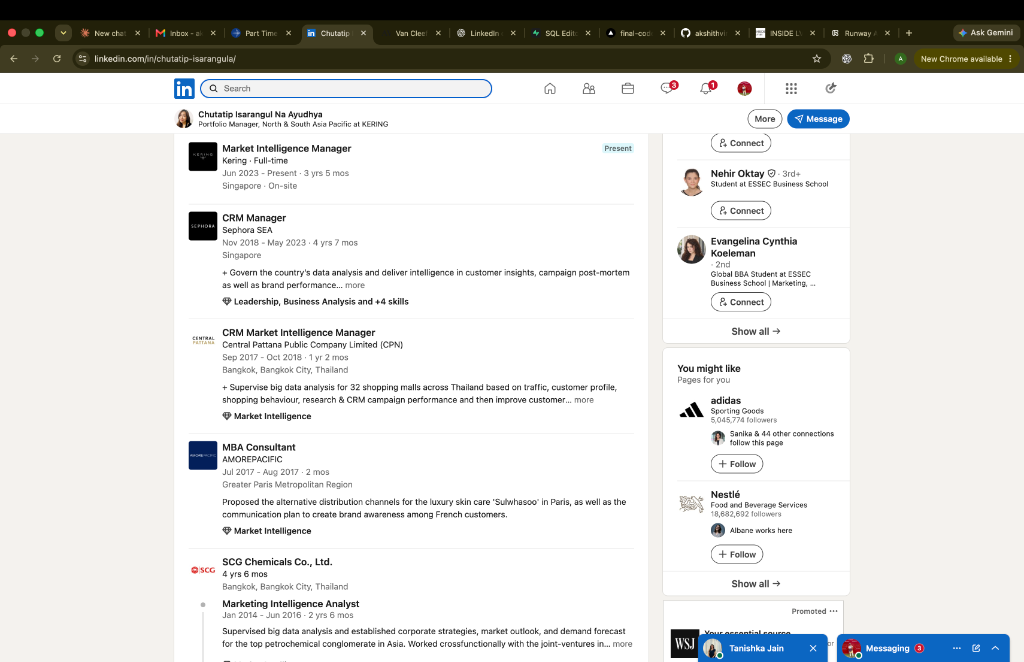
Chutatip's career path exemplifies how foundational analytical rigor builds long-term executive capability:
- SCG Chemicals: Market Intelligence Analyst, supervising corporate strategy & forecasting.
- AMOREPACIFIC: MBA Consultant, developing distribution strategy for Sulwhasoo in Paris.
- Central Pattana (CPN): CRM Market Intelligence Manager, analyzing consumer footfall across 32 shopping centers.
- Sephora SEA: CRM Manager, governing customer analytics & brand performance across Southeast Asia.
- Kering: Market Intelligence Manager transitioning to Portfolio Manager, North & South Asia Pacific.
Professional profile verified from official LinkedIn public records. Demonstrates how consumer data fluency translates directly into physical retail portfolio strategy.
Furthermore, Chutatip highlighted that networking is not about opportunistically begging industry executives for jobs. True professional networking is intellectual curiosity: seeking out practitioners to understand their operational challenges, learning their terminology, and building relationships based on mutual professional respect.
The goal of an interview is not to convince a company that you want an opportunity. It is to demonstrate that you understand their commercial opportunity and have thought deeply about how you can contribute.
Author's candidate thesis · reflecting on executive hiring dynamics
Learning to Think Like a Commercial Partner
Sitting in our ESSEC classroom in Singapore, listening to Chutatip unpack the mechanics of Kering's retail portfolio, prompted me to re-examine how I view my own future in marketing.
It is tempting for marketing students to isolate themselves inside the realm of high concepts: creative mood boards, emotional storytelling, and viral social media campaigns. But luxury marketing does not exist in an aesthetic vacuum. It lives on the boutique floor, in lease negotiations with mall developers, in inventory turns, and in the delicate commercial balance between capital investment and brand desirability.
The kind of professional I aspire to be is someone who respects the creative magic of a Maison while bringing unshakeable commercial discipline to its execution: someone who can look at a consumer insight, a store location, or a paid media budget and ask: what decision does this inform, how does it protect long-term brand equity, and what measurable value does it create?
I extend my sincere gratitude to Chutatip Isarangul Na Ayudhya for sharing her time, candor, and operational wisdom with our ESSEC Business School marketing cohort. Her generous insights illuminated how real-world luxury groups navigate market resets and provided a masterclass in how young professionals can cultivate meaningful, enduring careers in luxury.
Documentary Evidence & Disclosures
All corporate figures, market forecasts, and organizational policies referenced in this editorial are drawn from verified public disclosures and academic studies:
- Bain & Company & Fondazione Altagamma (June 2026). Mid-Year Luxury Outlook: Global Personal Luxury Goods Market Normalization. Documenting 2%–4% baseline industry growth projections. Business of Fashion Report →
- Bain & Company & Fondazione Altagamma (November 2025). 24th Global Luxury Study: Navigating Economic Headwinds and Shifting Consumer Behavior. Documenting contraction of consumer base from ~400M to 340M, -5% acquisition rate, and operating margins of 15%–16% vs. 23% in 2012. PR Newswire Disclosure →
- Kering S.A. (22 October 2026). Revenue for the Third Quarter of 2026. Official financial disclosure documenting consolidated revenue of €3.345B (-1% comp), retail traffic dynamics, 105 net store closures (9M26), and +11% Jewelry comp growth. Kering Corporate Press Release →
- LVMH Moët Hennessy Louis Vuitton (October 2026). Continued Growth in the Third Quarter of 2026. Official financial disclosure documenting -5% organic decline in Fashion & Leather Goods and +6% organic growth in Watches & Jewelry. LVMH Quarterly Publication →
- Kering S.A. (April 2026). ReconKering: Strategy, Group Platform & Operational Excellence. Corporate strategic documentation outlining Maison autonomy, shared platform synergies, client intelligence, and brand desirability restoration. Kering Corporate Strategy →
- Kering S.A. (2025/2026). Recruitment Privacy Policy & Talent Acquisition Architecture. Legal disclosure detailing candidate evaluation criteria, qualifications review, and AI-assisted skills-based matching platform. Kering Legal Recruitment Policy →
- Savills Research (2025). Global Luxury Retail Outlook 2025: Real Estate Resilience, Footfall Micro-Zoning, and Prime Corridor Strategy. Industry benchmark on store formats, prime avenue lease negotiations, and global cotenancy dynamics. Savills Research Report →
The Price of Desire: When Luxury Becomes More Expensive, Does It Become More Desirable?
Deep-dive investigation into Gucci's pricing recalibration (€3,500 down to €2,450 on seasonal Padlock bags), Kering CFO Armelle Poulou's clarification, LVMH CFO Cécile Cabanis's pricing stance, and why luxury brands must justify price with craft.
The Luxury of Being Remembered: Clienteling, AI & High Jewelry
How Johannes Adder (Retail Director SEA) balances intimate salon memory with AI discovery across high jewelry clienteling.
SK-II · Procter & GambleSK-II: How Do You Get Back in the Game When the Rules Change?
How Helene Bellamy (SVP Global SK-II) navigates category entry points, distinctive brand assets, and turnaround strategy.